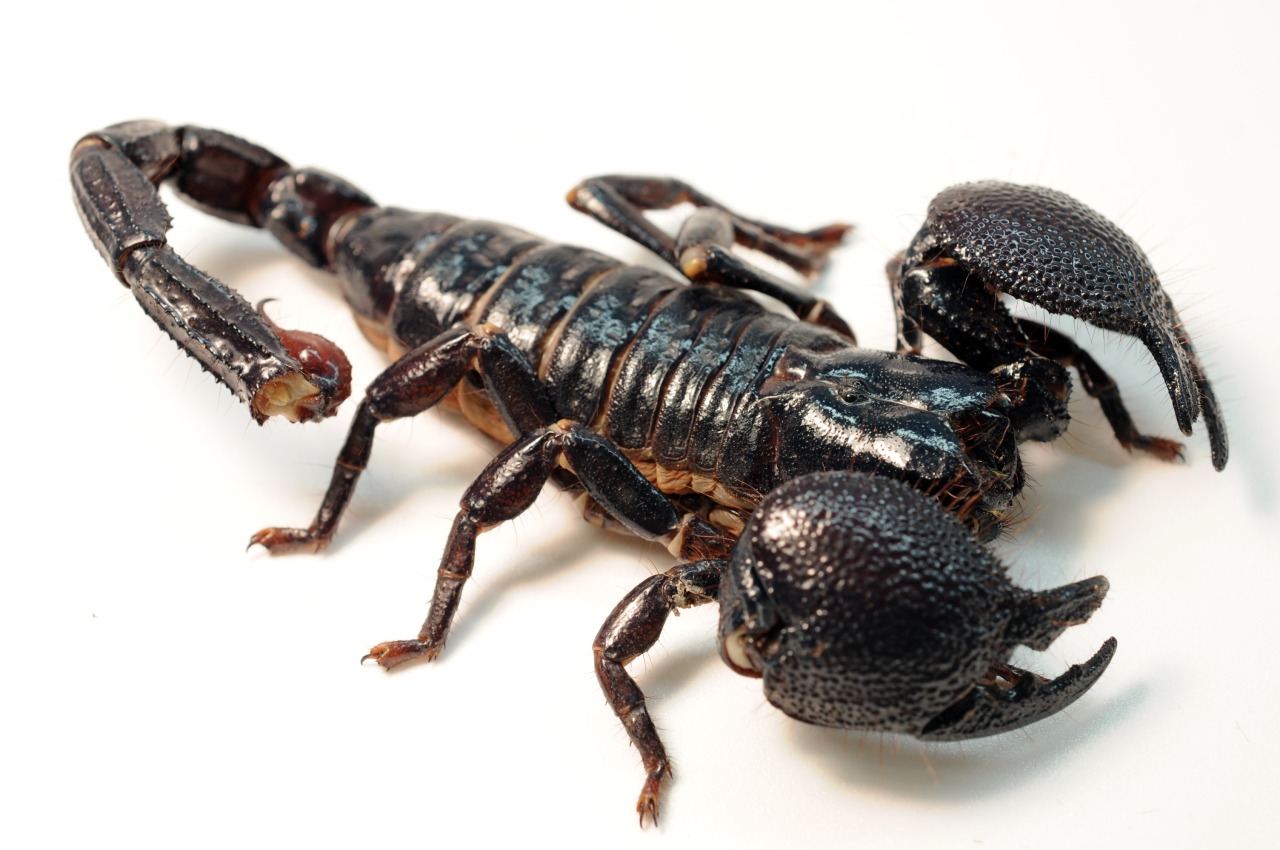
Emperor scorpions are large, glossy black West African scorpions long popular in the U.S. pet trade. They are docile relative to other scorpions, with mild venom roughly comparable to a bee sting in most healthy adults — though allergic reactions are possible.
ℹ️
Educational only. KinStation content is reviewed by licensed veterinarians but cannot replace an in-person exam. Always consult a licensed veterinarian or board-certified specialist for diagnosis, treatment, or any decision affecting your pet's health.
🩺 Need expert help with your emperor scorpion?
Connect with a specialist near you or ask a licensed vet — never substitute online guidance for hands-on care in an emergency.
Adults 6–8 inches body length; females larger and more robust than males.
Lifespan
6–8 years
Social needs
solo
Native region
West Africa (tropical rainforest and savanna)
Origin
Old World
Climate
🌴 Tropical
Family
Scorpionidae
Genus
Pandinus
Part of the Scorpions
Scorpions are long-lived arachnids kept as hardy display invertebrates. Most are defensive, not for handling, and range from mild-venom desert species to potent old-world species suited only to experienced keepers.
From the minimum an animal needs to be kept humanely, up to the ideal setup. Bigger is almost always better — minimums are floors, not targets.
Photo coming soon
Minimum
Adult terrestrial terrarium
≈ 12 × 12 × 12 in (≈ 10-gal)
A single adult needs a humid, secure terrarium with at least 4–6 in of moisture-retaining coco-fibre or coir to burrow into, multiple cork-bark or flat-rock hides, and a shallow water dish. Keep warm at 25–30 °C (gentle under-tank heat on one side, never a drying overhead lamp) with high humidity around 75–80% and good ventilation to avoid mould. Emperor scorpions are best kept singly — a lone adult is the safe, humane default.
Photo coming soon
Recommended
Burrowing terrarium
≈ 18 × 12 × 12 in (≈ 20-gal long)
A horizontal terrarium with 6+ in of deep, packable coco-fibre/sphagnum substrate for genuine burrow construction, several stacked hides, leaf litter, and a large water dish. Maintain a 25–30 °C gradient with under-tank heat on one side and 75–80% humidity by misting and keeping the lower substrate damp. The roomy footprint lets this fossorial species dig and ambush naturally as a single occupant; co-housing is risky and only for experienced keepers, never a welfare requirement.
Photo coming soon
Ideal
Bioactive rainforest terrarium
≈ 24 × 18 × 18 in (≈ 30+ gal)
A planted, bioactive tropical terrarium with 6–8 in of deep substrate, a springtail and tropical isopod cleanup crew, abundant cork bark, leaf litter, and live plants under gentle warmth (no harsh basking lamp). Hold a stable 25–30 °C gradient and 75–80% humidity with a permanent water source to mirror the humid West African forest floor. Generous space and many hides for a single scorpion — with deep burrowing room and a stable microclimate — is the most enriched outcome; this species does not require companions.
Life & growth stages
How this animal changes through its life — each stage often has its own care, diet and space needs.
Photo coming soon
Egg
These invertebrates lay eggs — often in a guarded clutch, a silk sac (spiders), or a brood (carried by female isopods). The eggs are small and soft and develop without a true larval or pupal transformation.
Photo coming soon
Juvenile
Juveniles hatch as miniature versions of the adult and grow by molting their exoskeleton (or, in snails, by enlarging the shell). They gain size, segments, or leg pairs and gradually take on adult coloration with each molt.
Adult
Adults reach full size and reproductive maturity with the species' mature form and coloration. Many arachnids and myriapods continue to molt as adults, and sexes can differ in size or in specialized appendages.
Habitat & enclosure
Emperor scorpions are large, tropical, terrestrial scorpions that need a warm, humid terrarium with ample floor space and secure ventilation. A modest enclosure suits a single adult, with more space for a small group, since this is one of the more tolerant scorpions of cohabitation when well fed and well housed — though crowding or underfeeding risks aggression, so many keepers keep them singly to be safe.
Provide a deep layer of moisture-retaining substrate (coconut fiber or a soil mix) for burrowing, plus hides such as cork bark or half-logs, because emperors are secretive and spend much time concealed. As a rainforest species they require high humidity, maintained by misting and a damp substrate, balanced against good ventilation to avoid mold; a shallow water dish should always be available.
Warm temperatures appropriate to a tropical species are important, typically provided so the enclosure stays comfortably warm without hot spots that could harm the animal. A snug lid is essential. Like tarantulas, emperor scorpions are observe-don't-handle animals; a secure, humid, hide-rich enclosure keeps them calm and healthy.
Substrate
Provide 4-6 inches of moist coconut fiber or peat/soil mix that holds a burrow shape, since these communal forest scorpions dig and need high humidity. Keep the substrate damp but not waterlogged and mist as needed to maintain roughly 75-80% humidity.
Equipment & setup
Use a 10-20 gallon enclosure kept at 78-86F, warmed by a thermostat-controlled heat mat on the side wall rather than underneath. Offer multiple cork-bark or flat-rock hides, a large shallow water dish, and avoid bright lighting, as they are nocturnal and light-shy.
Diet
Emperor scorpions are carnivores fed appropriately sized live feeder insects such as crickets and roaches, with larger adults sometimes taking bigger prey. Feeding frequency depends on size and appetite; juveniles eat more often than adults, and a well-fed adult may eat relatively infrequently. Remove uneaten prey so it cannot stress or harm the scorpion, particularly around molts.
A shallow dish of fresh water should always be available, and the humid substrate also contributes to hydration. As with other inverts, a scorpion in premolt may stop eating and should be left undisturbed.
Common mistakes include overfeeding, leaving live prey with a molting or non-feeding animal, and letting the enclosure dry out. When prolonged food refusal is paired with other signs of illness, an exotic/invertebrate-experienced veterinarian can advise.
Behavior & temperament
Despite an intimidating appearance — heavy build, large pincers — emperor scorpions are famously among the most docile scorpions, generally preferring to pinch or flee rather than sting. They are nocturnal and secretive, spending daylight hours burrowed or hidden and emerging at night to hunt and explore.
They possess venom, but for this species it is typically described as mild, with a sting often compared to a bee sting; nonetheless, allergic reactions are possible, the large pincers can give a painful nip, and individual temperament varies, so handling is discouraged. This is a display animal best appreciated in its enclosure rather than on the hand.
When kept in groups, emperors can coexist relatively peacefully if space and food are ample, but stress, crowding, or hunger can lead to cannibalism, so many keepers house them singly. A calm, humid, hide-rich environment with minimal disturbance brings out their naturally placid behavior.
Health
Emperor scorpions are moderately long-lived invertebrates, commonly living several years (often cited around 6 to 8 years) with good care. As with tarantulas, most health issues are husbandry-related rather than infectious.
The main concerns are improper humidity (too dry causes dehydration and molting problems; too wet without ventilation invites mold and mite outbreaks), falls or injuries, and molting complications, which are a vulnerable time when the animal must be left undisturbed. Mite or fungal problems often trace back to overly damp, poorly ventilated conditions or uneaten prey.
Preventive themes are appropriate warmth and humidity with good ventilation, a deep burrowing substrate, hides, a clean enclosure with prey removed promptly, and minimal handling. Specialized invertebrate veterinary care is uncommon, but an exotic veterinarian can advise where illness is suspected. This entry is general guidance only.
Tips, DIY & hacks
Emperors can be kept communally if well-fed with ample hides and floor space to prevent cannibalism. A low-wattage red or blackout setup lets you observe nighttime activity, and gut-loaded crickets or roaches plus the occasional dusted feeder keep them healthy.
Origin & history
The emperor scorpion (Pandinus imperator) is native to the tropical rainforests and savannas of West Africa. As one of the largest scorpion species, with a docile temperament and a dramatic appearance, it became a flagship of the invertebrate pet trade and a popular 'first scorpion.'
That heavy collection for the pet trade prompted conservation safeguards: the emperor scorpion is listed under CITES Appendix II, meaning international trade is regulated to prevent over-harvesting of wild populations, and captive breeding has grown to help meet demand. It is a wild species, not domesticated.
Anecdotes & owner lore
Community experience and cultural notes — not veterinary advice. Every animal is an individual; treat these as colour, not care instructions.
Emperor scorpions have a party trick that never gets old: under ultraviolet (blacklight) light, their exoskeleton glows an eerie, vivid blue-green, thanks to fluorescent compounds in the cuticle. Keepers love switching off the lights and lighting up the terrarium, and the phenomenon is a favorite of museum and classroom 'bug nights.'
Their fearsome look versus gentle reality makes them a staple of films, photo shoots, and 'hold a scorpion' attractions — a giant black scorpion that is, for most people, no worse than a bee if it ever stings. Hobbyists are delighted that emperors can sometimes be kept communally and will share burrows, and they swap stories of glow-in-the-dark feeding nights and of surprisingly tidy scorpions excavating elaborate tunnels beneath their hides.
Common ailments
Dehydration — common — Emperor scorpions are humidity-dependent; keeping the enclosure too dry is a frequent husbandry error.
Molting complications — common
Mite or mold problems — common
Legality (US)
Educational only. Confirm current rules with your state wildlife agency or local authority before acquiring an animal.
US — Regulated — Pandinus imperator is on CITES Appendix II — international commercial trade requires permits. U.S. captive-bred individuals are legal to own and trade domestically.
Reviewed and signed off by: KinStation Editorial - pre-launch draft (pending DVM review)