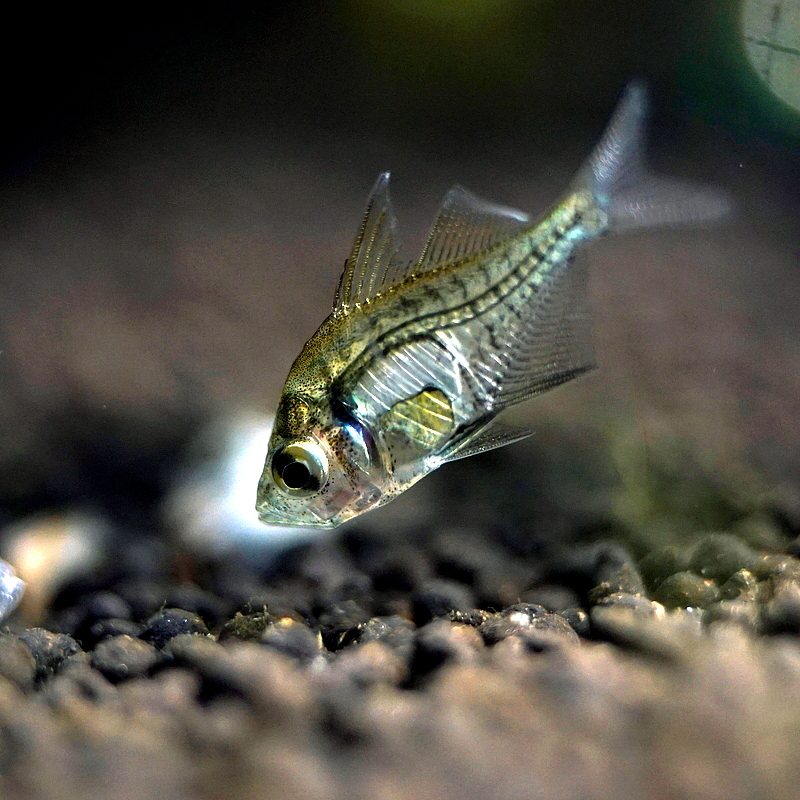
A small, transparent schooling fish from South and Southeast Asia whose see-through body reveals its skeleton and internal organs. A genuine oddball best kept in groups, it is notorious for being sold artificially dyed — a cruel practice buyers should refuse.
ℹ️
Educational only. KinStation content is reviewed by licensed veterinarians but cannot replace an in-person exam. Always consult a licensed veterinarian or board-certified specialist for diagnosis, treatment, or any decision affecting your pet's health.
🩺 Need expert help with your indian glassfish?
Connect with a specialist near you or ask a licensed vet — never substitute online guidance for hands-on care in an emergency.
Slow fresh and brackish waters of South and Southeast Asia (India, Bangladesh, Myanmar)
Origin
Old World
Climate
🌴 Tropical
Water type
💧 Freshwater
Family
Ambassidae
Genus
Parambassis
Part of the Freshwater oddballs
Unusual, conversation-piece freshwater fish — knifefish, elephantnoses, bichirs, butterflyfish and other novelties prized for strange shapes, behaviors or electric senses rather than schooling color.
From the minimum an animal needs to be kept humanely, up to the ideal setup. Bigger is almost always better — minimums are floors, not targets.
Photo coming soon
Minimum
Shoal community
20 gal / 76 L long
Parambassis ranga reaches 3 in. 20-gal long minimum for a shoal of 6+, with slightly brackish to fresh water (often listed FW but tolerates SG 1.002–1.005), peaceful tankmates, and live or frozen food.
Photo coming soon
Recommended
Brackish shoal display
29 gal / 110 L long
29-gal long low-end brackish with a shoal of 8+, plants tolerant of slight salt, driftwood, and peaceful tankmates. NEVER buy dyed/painted glassfish.
Photo coming soon
Ideal
Brackish biotope shoal
40 gal+ / 151 L+ biotope
Low-end brackish biotope with mangrove roots, sand, hardy plants, and a shoal of 10+. Striking transparent body — best contrast against darker substrate.
Life & growth stages
How this animal changes through its life — each stage often has its own care, diet and space needs.
Photo coming soon
Egg
Fish eggs are small, translucent spheres, often laid in clutches on plants, substrate, or in a nest — or carried/brooded by a parent in livebearing and mouth-brooding species. A dark eye spot and the curled embryo become visible inside as development progresses.
Photo coming soon
Fry
Newly hatched fry are tiny and semi-transparent, frequently still carrying a yolk sac that fuels them before they feed freely. They lack full fin structure and adult coloration, staying near cover until they can swim and forage on their own.
Photo coming soon
Juvenile
Juveniles look like miniature adults but with developing fins and muted or different markings; many species shift pattern and color as they mature. Growth is rapid at this stage given clean water and steady feeding.
Adult
Adults show the species' full size, finnage, and mature coloration, and are sexually mature. Many fish develop sex-specific differences in size, color, or fin shape, which can intensify during breeding.
Color & pattern variants
Natural variants occur in the wild; selectively bred (man-made) variants were developed in captivity.
Keep a group of six or more in at least 75 L (20 gal). It tolerates a wide range but does best in neutral to slightly alkaline, moderately hard water, pH 7.0-8.0, temperature 20-28 C (68-82 F); a little aquarium salt is optional but not required. Gentle to moderate flow suits it.
Provide open mid-water swimming space framed by plants and driftwood. Subdued lighting and a darker substrate make the translucent body and the males' fin coloration show beautifully.
Substrate
Use a dark sand or fine gravel substrate to contrast the transparent body and reduce glare. Aquascape with plants and wood to provide security while leaving open swimming lanes.
Equipment & setup
A gentle filter (sponge or baffled hang-on-back), a heater, and modest lighting are all that is needed. No protein skimmer or specialized gear is required for this freshwater species; live or frozen food cultures are the most useful 'equipment.'
Diet
Micropredator. Prefers small live and frozen foods — daphnia, brine shrimp, cyclops, bloodworms, mosquito larvae — and may be slow to accept flake or micro-pellets. Variety and live foods bring out the best color and condition.
Behavior & temperament
Peaceful, slightly timid schooling fish that loses confidence kept alone or in small numbers; males display and spar harmlessly within the group. House with similarly sized, calm tankmates such as small rasboras, danios, and peaceful gouramis. Avoid large or boisterous fish that intimidate it.
Health
Generally hardy in stable water but sensitive to poor quality and stress, which invites ich and fungal issues. Crucially, avoid 'painted' or 'disco' glassfish: the injected dye causes infections, tumors, and shortened lives, and dyed fish are often weakened. Only buy naturally clear specimens.
Tips, DIY & hacks
Refuse dyed 'painted glassfish' — the artificial coloring is injected and harmful, and fish should be naturally transparent. Keep them in shoals of 6+ and offer live or frozen foods to encourage feeding and breeding. A planted, dimly lit tank with darker substrate dramatically improves their appearance and confidence.