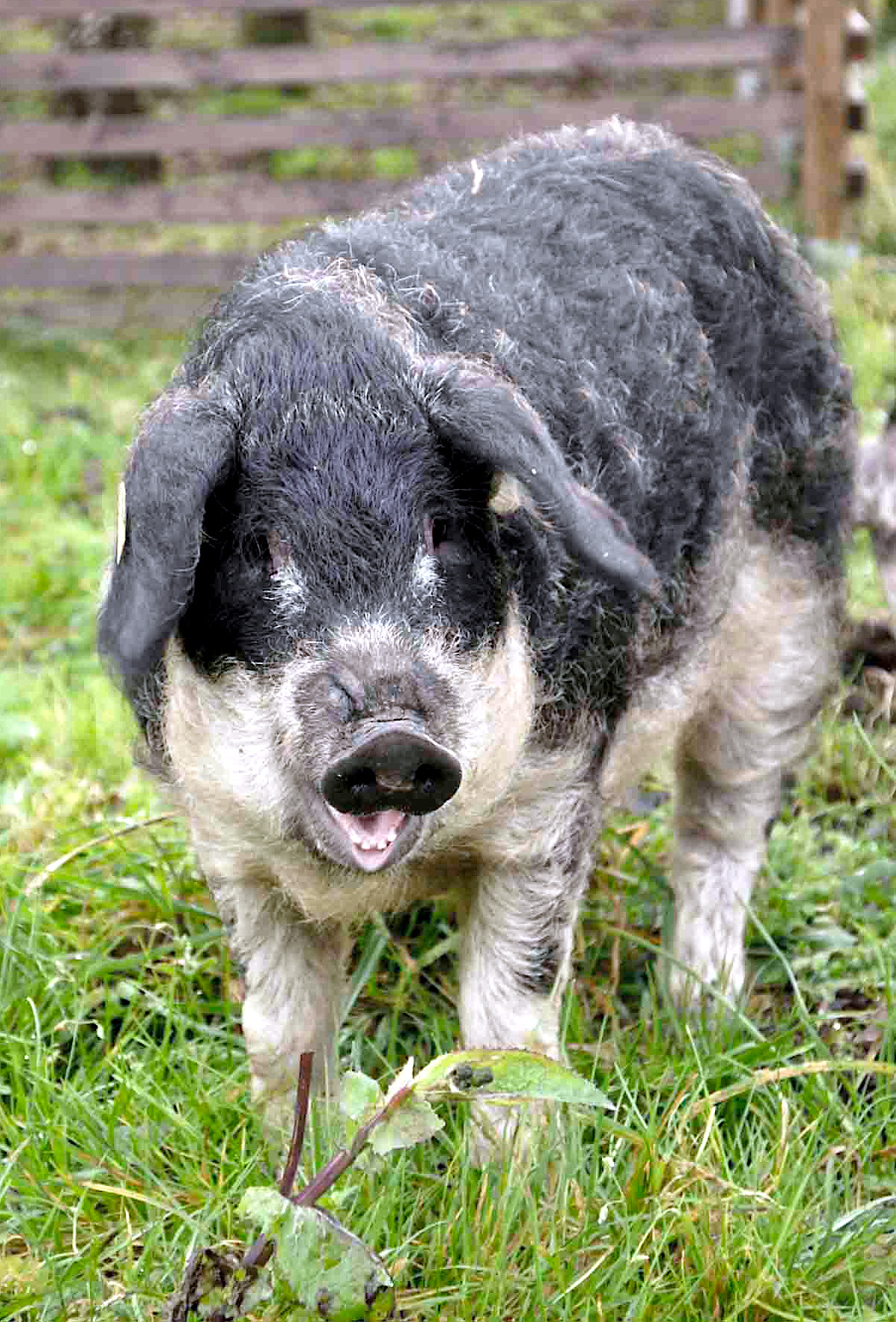
A rare Hungarian lard breed instantly recognizable by its dense, curly sheep-like fleece, the Mangalitsa is a slow-growing, extremely hardy pig prized for heavily marbled, high-fat 'Kobe-of-pork' meat and charcuterie. Its woolly coat lets it thrive outdoors in cold climates.
ℹ️
Educational only. KinStation content is reviewed by licensed veterinarians but cannot replace an in-person exam. Always consult a licensed veterinarian or board-certified specialist for diagnosis, treatment, or any decision affecting your pet's health.
🩺 Need expert help with your mangalitsa?
Connect with a specialist near you or ask a licensed vet — never substitute online guidance for hands-on care in an emergency.
From the minimum an animal needs to be kept humanely, up to the ideal setup. Bigger is almost always better — minimums are floors, not targets.
Photo coming soon
Minimum
Pen + wallow + 3-sided shelter
≥ 50 sq ft per pig in pen, hog-rated fencing
A bare-minimum pen with ≥ 50 sq ft per pig, a wallow for thermoregulation, a 3-sided shelter, and hog-rated fencing (woven wire or hot wire). Pigs are herd animals — solo housing is poor welfare, keep at least a pair.
Recommended
Rotated paddock with shelter
1/8–1/4 acre per pig, rotated
Rotated paddocks of 1/8–1/4 acre per pig with a wallow, a barn or sturdy shelter, sturdy fencing, and a farrowing crate option for sows. Rotation prevents parasite build-up and gives fresh rooting ground.
Michal Jakubský / CC BY 3.0 (Wikimedia Commons)
Photo coming soon
Ideal
Managed pasture + woodland
Multi-acre rotation, woodland + wallow, herd of 4+
Managed pasture rotation with access to woodland for natural rooting, a wallow, shade, and a herd of 4+ for social structure. Heritage breeds in this setup preserve genetic diversity and express the full pig behavioural repertoire.
Life & growth stages
How this animal changes through its life — each stage often has its own care, diet and space needs.
Photo coming soon
Newborn
Newborn mammals are nursed on their mother's milk. Many are born helpless — blind, deaf, and sparsely furred (altricial, as in dogs, cats, and rodents) — while others stand and follow within hours (precocial, as in hoofed livestock).
Photo coming soon
Juvenile
After weaning, juveniles grow quickly and become increasingly active, playful, and independent. Adult coat, proportions, and (in many species) the permanent teeth come in as they approach full size.
Photo coming soon
Adult
Adults reach full body size and sexual maturity, with the species' mature coat and build. Sexual dimorphism — differences in size, mane, horns, or markings — is pronounced in some mammals and subtle in others.
Senior
Senior animals show aging signs such as graying fur, reduced activity, and a greater need for veterinary monitoring of joints, teeth, and organ function. Lifespan and the onset of old age vary widely by species and size.
Color & pattern variants
Natural variants occur in the wild; selectively bred (man-made) variants were developed in captivity.
A **cold-hardy outdoor and pasture/woodland breed** — the woolly fleece insulates it through harsh winters with only a dry, draft-free shelter or ark. Provide ample range for foraging and rooting and **strong fencing**. The thick coat means **heat is the real risk**: provide generous **shade and a wallow** in summer, and avoid hot, humid confinement. Straw-bedded shelter; thrives on extensive, low-input management.
Diet
Omnivorous and an excellent forager on pasture, acorns, roots, and woodland mast — the traditional finishing diet. As a **lard/fat-type breed it fattens very readily**, so rations must be controlled: a moderate, balanced feed plus forage, **avoiding excess energy** to prevent obesity and breeding problems. Slow-growing — expect 12-18 months to finish rather than the few months of commercial pigs. Provide fresh water and a wallow; follow local swill-feeding laws.
Behavior & temperament
**Purpose: high-fat lard and premium marbled meat/charcuterie (lardo, salami, prosciutto-style products).** Temperament is generally **calm, docile, and good-natured**, though they remain active foragers. The breed grows slowly and lays down abundant fat, which is the point — the meat is intensely marbled. Sows are hardy, attentive mothers but produce **smaller litters (typically 5-8)** than commercial breeds. Piglets are born with a striped 'wild boar' pattern that fades.
Health
**Extremely hardy and long-lived with few genetic disorders**, owing to its primitive, low-selection background. The chief welfare risks are **management-related: obesity and heat stress.** The dense fleece makes the breed prone to **overheating** in hot weather (shade and wallows essential) and can harbor **lice/mange**, so coat inspection and parasite control matter. Over-fattening breeding stock reduces fertility — keep condition moderate. Otherwise robust with good leg and constitution soundness.
Tips, DIY & hacks
Plan for a **long finishing time (12-18+ months)** and budget feed accordingly — this is a slow-growth premium breed, not a fast commercial pig. **Control feed energy** to avoid obesity; let forage do much of the work. Manage the woolly coat for **summer heat** with reliable shade and a wallow, and inspect the fleece regularly for **lice and mange**. Buy from registered breeders within recognized color lines (Blonde, Swallow-belly, Red) and keep pedigree records, as the breed is rare. The high-fat carcass is best valued through charcuterie and lardo rather than lean-pork markets.