Bounce Mushroom
Rhodactis indosinensis · also called Bounce Shroom, OG Bounce, Inflated Rhodactis

The 'Bounce Mushroom' is a highly sought, high-value phenotype of Rhodactis (trade-attributed to R. indosinensis) covered in inflated, balloon-like vesicles. Genetically a mushroom corallimorph, but the prized bubble trait makes it slower-growing and pricier than ordinary shrooms.
🩺 Need expert help with your bounce mushroom?
Connect with a specialist near you or ask a licensed vet — never substitute online guidance for hands-on care in an emergency.
Quick facts
| Size | Polyps 1-3 in (2.5-7.5 cm) across; slow to spread compared to common mushrooms |
| Lifespan | 10–25 years |
| Social needs | group |
| Native region | Indo-Pacific reef slopes, lagoons and channels (Indonesia, Tonga, Fiji) |
| Origin | Old World |
| Climate | 🌴 Tropical |
| Water type | 🌊 Marine |
| Family | Discosomidae |
| Genus | Rhodactis |
Part of the Mushroom Corals
Soft, disc-shaped corallimorphs (Rhodactis, Discosoma, Ricordea, and bounce morphs) that carpet rockwork in fluorescent colors. Hardy, low-light, low-flow, and among the best beginner reef invertebrates.
Habitat & space requirements
From the minimum an animal needs to be kept humanely, up to the ideal setup. Bigger is almost always better — minimums are floors, not targets.
Life & growth stages
How this animal changes through its life — each stage often has its own care, diet and space needs.
Color & pattern variants
Natural variants occur in the wild; selectively bred (man-made) variants were developed in captivity.
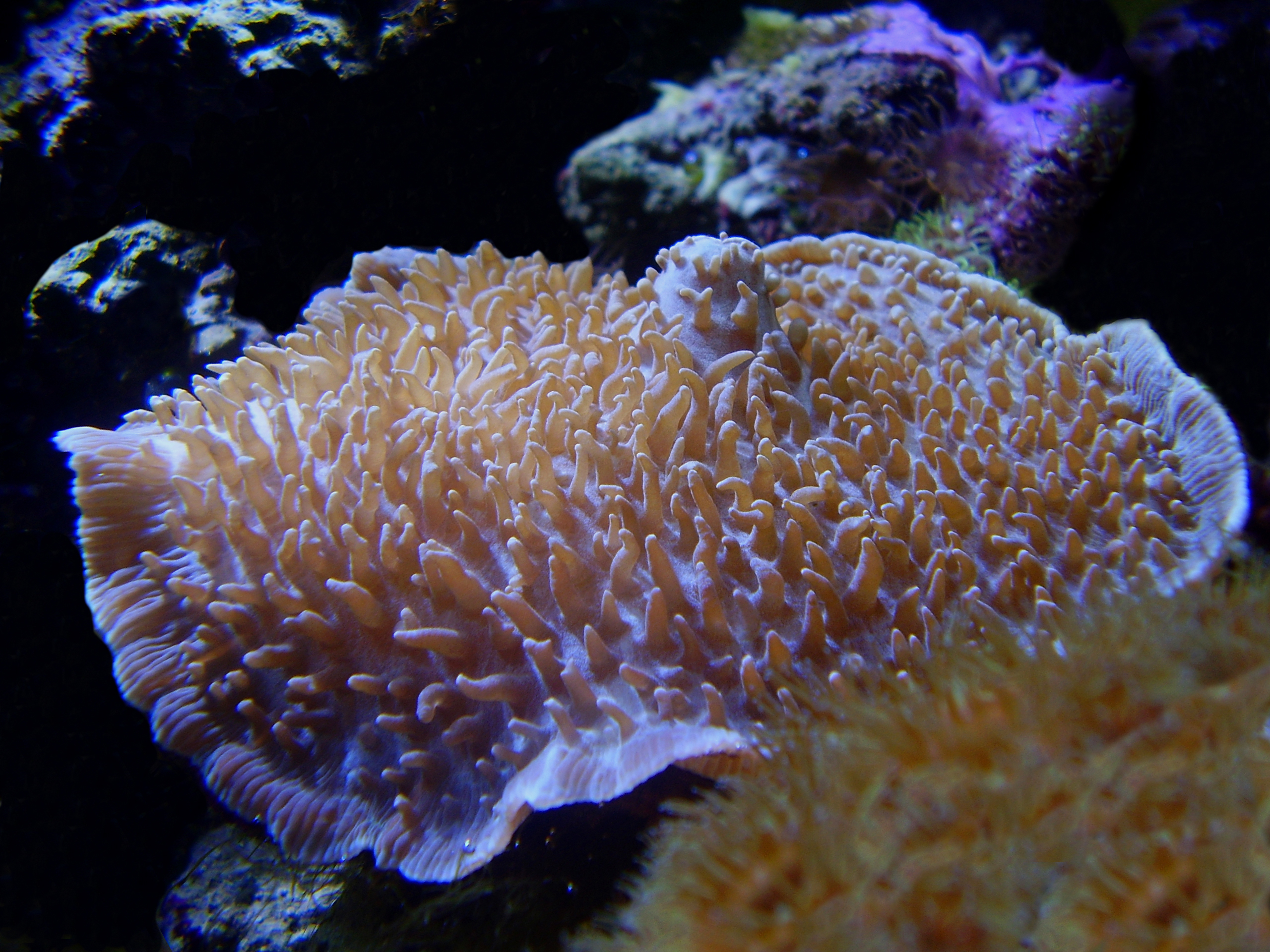 representative
OG Bounce
The original imported bounce phenotype — earthy base with scattered colorful inflated bubbles; the foundation for most named bounces.
representativeRainbow Bounce
Premium multicolor morph with red, green, orange and blue bubbles across a single disc; among the highest-priced corals in the hobby.
 representative
Sunkist / Orange Bounce
Bright orange-to-yellow bubble field; a popular, intensely fluorescent color variant.
representativeWWC OG Bounce →
The original, foundational bounce mushroom: a teal-to-green disc studded with fat, inflated orange and yellow vesicles ("bounces"), with hints of purple. Not a rainbow morph, but the bubble structure that defined the entire trade category. WWC describes the OG as having uniquely massive vesicles that most later bounces don't match.
Tip: Place low in the rock or on the sandbed in low flow and low-to-moderate light (under roughly 75-150 PAR); harsh flow or strong light flattens the prized bubbles. Target-feed small meaty foods weekly to keep the vesicles plump.
representativeSunkist Bounce →
A bright citrus-orange bounce: typically a blue-green disc carrying fat, fully tangerine "sunkist" vesicles that fluoresce hard under blues. One of the most recognizable orange bounces in the trade.
Tip: Give it stable low flow and low-to-moderate blue-heavy light low in the tank; target-feed small meaty foods weekly to keep the vesicles plump and colored up.
representativeJF Raunchy Red Bounce →
A blue-based bounce with raised red frills and red bubbles; the outer tentacles shift between orange, yellow and red depending on lighting. A bold red-and-blue contrast piece that stays red in any light.
Tip: Use blue-rich light low in the tank to pop the red vesicles, and keep flow gentle so the inflated bubbles stay raised; feed lightly to maintain the red coloration.
representativeFrankenstein Bounce →
A patchwork bounce splattered with green, orange, red and purple zones over big inflated vesicles, often offered in a higher-grade "Rainbow Frankenstein" version. The chaotic mottled coloration earns the "Frankenstein" name.
Tip: Place low in low flow under moderate blues; the more even and gentle the conditions, the better the vesicles inflate and the mottled colors hold.
representativeGodspawn Bounce →
A high-color collector bounce, predominantly blue-based with mixed warm and neon vesicles. Generally carries smaller and fewer bubbles than the WWC/OG, though standout pieces approach OG-level bubble density.
Tip: Settle it low in the rockwork in low flow and feed lightly; like other premium bounces it sulks in strong current, so keep the bubbles relaxed and inflated.
representativeInterstellar Bounce →
A painted-style bounce with swirled multicolor pigment across the disc and inflated pseudotentacles, the colors shifting noticeably under blue light. Essentially a fancy "painted Rhodactis" that bounces.
Tip: Use blue-heavy light low in the tank to swell and color the pseudotentacles, and keep flow low so they inflate fully.
representativeSkittle Bounce →
A multicolor candy-toned Rhodactis bounce mixing reds, oranges, greens and yellows reminiscent of skittles, set over inflated vesicles. A mid-tier collector bounce.
Tip: Keep low in low flow under moderate blues; avoid blasting it with current so the bubbly vesicles hold their shape and color.
representativeIndo Toxic Bounce →
A toxic-green Indonesian Rhodactis bounce with bright acid-green coloration and raised vesicles. A solid-color collector bounce named for its almost neon "toxic" green.
Tip: Give it blue-rich light low in the tank to bring out the toxic green fluorescence, with gentle flow to preserve the inflated bubbles.
representativeKing Julius Bounce →
A WWC house bounce: a blue-to-purple disc carrying orange and gold vesicles. A large, well-established named Rhodactis bounce that WWC grows out to display size.
Tip: Place very low in the reef in low flow under less than ~100 PAR; WWC recommends target feeding roughly once per week to speed growth and budding.
representativePowerball Bounce →
A bulbous, vibrantly colored Rhodactis bounce known for dense, well-developed vesicles. A recognizable named bounce in current vendor catalogs.
Tip: Target moderate PAR (~70-120) and gentle flow; too much light or harsh, direct current flattens the bubbles, while very lean water also reduces vesicle inflation.
representativeInsanity Bounce →
A named bounce with fluorescent neon-orange vesicles over a light sky-blue base and a forest-green body. A high-contrast collector Rhodactis bounce.
Tip: Keep low in the tank in low flow under moderate blue-leaning light; feed lightly and avoid strong current so the neon vesicles stay inflated and colored.
representativeKryptonite Bounce →
An intensely bright neon-green Rhodactis bounce that glows almost radioactively under actinics, with raised green vesicles. A vivid solid-color bounce.
Tip: Run blue-rich/actinic light low in the tank to maximize the neon fluorescence, with gentle flow to keep the vesicles raised.
representativeUranium Bounce →
A glowing yellow-green "uranium" toned Rhodactis bounce with bubbly vesicles, sold as a vivid fluorescent collector mushroom. Closely related in look to the neon green bounces.
Tip: Place low under blue-leaning light to push the fluorescent glow and keep current gentle so the bubbles stay inflated; too much flow can detach it from the rock.