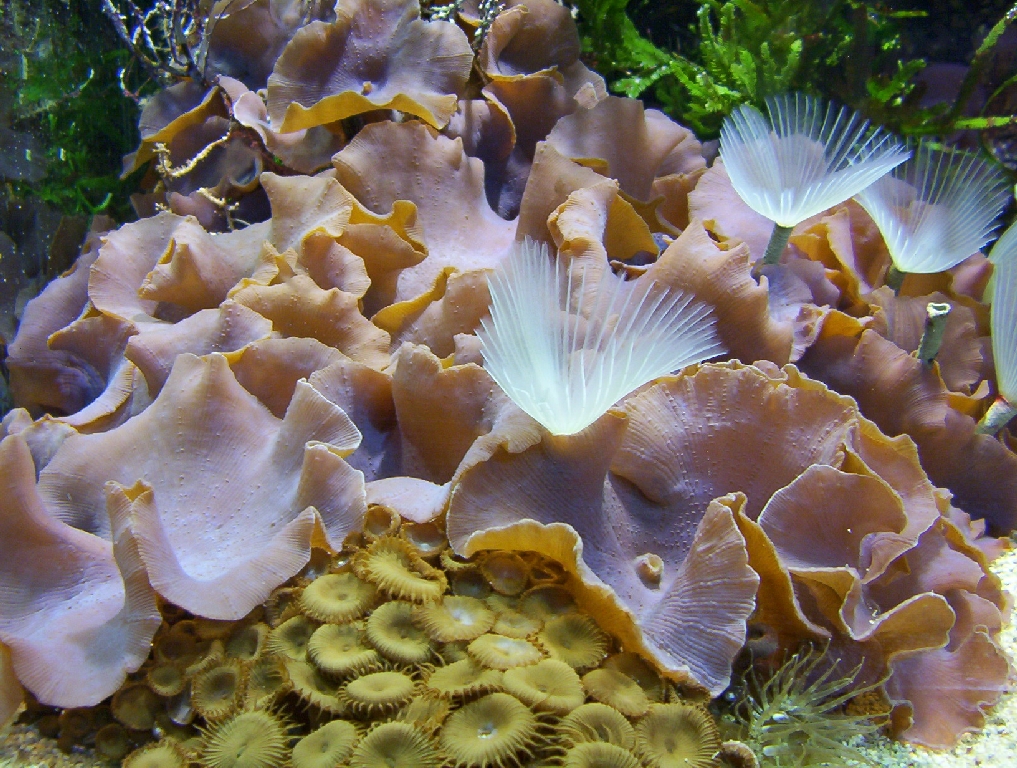
Trade 'Discosoma' (Actinodiscus) mushrooms are the classic smooth-disc 'red mushrooms' — among the hardiest, most beginner-proof reef invertebrates, multiplying readily into colorful carpets under low light and flow. Hobby species identity is muddled, so they are best labeled Discosoma sp.
ℹ️
Educational only. KinStation content is reviewed by licensed veterinarians but cannot replace an in-person exam. Always consult a licensed veterinarian or board-certified specialist for diagnosis, treatment, or any decision affecting your pet's health.
🩺 Need expert help with your discosoma (red mushroom)?
Connect with a specialist near you or ask a licensed vet — never substitute online guidance for hands-on care in an emergency.
Soft, disc-shaped corallimorphs (Rhodactis, Discosoma, Ricordea, and bounce morphs) that carpet rockwork in fluorescent colors. Hardy, low-light, low-flow, and among the best beginner reef invertebrates.
From the minimum an animal needs to be kept humanely, up to the ideal setup. Bigger is almost always better — minimums are floors, not targets.
Photo coming soon
Minimum
Stable nano reef
10+ gal / Alk 8-9 / NO3 5-15
Mushroom corals are the easiest "coral" for new reefers — low light, low flow, tolerate higher nutrients. Place low. Detaches/walks if unhappy. Discosoma (Red/Blue/Striped Mushroom) is the classic mushroom coral — smooth disc, very forgiving.
Photo coming soon
Recommended
Established 30-gal reef
30+ gal cycled 6+ mo
Established reef with shaded/low light + low flow. Frag-friendly and spreads.
Photo coming soon
Ideal
Mature reef + dedicated mushroom garden
75+ gal / display rock with named morphs
Mature reef with named mushroom morphs in a shaded zone — Bounce, Yuma, Ricordea morphs reach show colour with stable params. Discosoma (Red/Blue/Striped Mushroom) is the classic mushroom coral — smooth disc, very forgiving.
Life & growth stages
How this animal changes through its life — each stage often has its own care, diet and space needs.
Photo coming soon
Planula larva
Corals begin as a free-swimming planula larva released into the water column after spawning or brooding. The tiny, ciliated larva drifts and swims until it finds suitable hard substrate to settle on.
Photo coming soon
Single polyp
Once settled, the larva metamorphoses into a single founding polyp that secretes a calcium-carbonate (or proteinaceous) base and extends a ring of tentacles to feed. Reef-building corals begin laying down skeleton at this stage.
Mature colony
The founding polyp buds asexually into a colony of many genetically identical polyps, building the species' characteristic growth form — branching, plating, encrusting, or massive. A mature colony can reproduce and contributes to reef structure.
Color & pattern variants
Natural variants occur in the wild; selectively bred (man-made) variants were developed in captivity.
Natural
representative
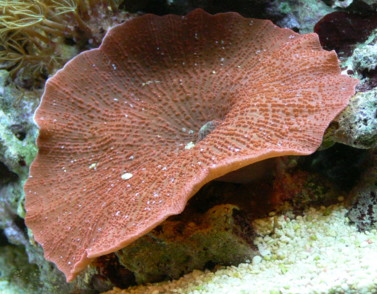
Red / Crimson
Deep red to maroon smooth disc — the original and most common 'red mushroom' color form.
representative
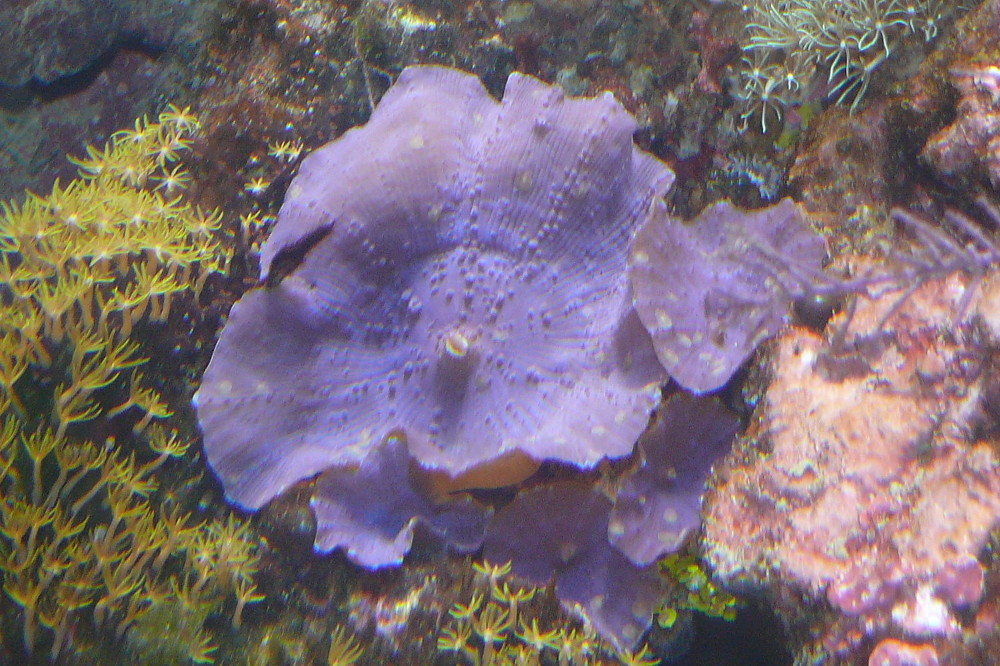
Blue
Metallic blue-disc morph that fluoresces under actinic lighting; a more sought-after color variant.
representative
Superman
Striking red-and-blue mottled disc named for the comic palette; a premium hobby selection.
Thrives in almost any **established reef tank, 5-10 gal (19-38 L) and up**, including nano and low-tech setups. Tolerant of moderately elevated nutrients. Parameters: temperature **75-80 F (24-27 C)**, salinity **1.024-1.026 SG**, pH **8.1-8.4**, alkalinity **8-11 dKH**, calcium **400-450 ppm**. Place low on rockwork where light and flow are gentle.
Substrate
Anchors to **live rock or frag plugs**. Seat cut pieces in a perforated cup with rubble in gentle flow until attached. Not a sand species, though detached polyps may temporarily settle on sand before climbing onto rock.
Equipment & setup
Undemanding: heater, salt mix, basic filtration, and **low to moderate reef lighting (PAR ~30-100)**. Low flow preferred — strong flow makes discs curl and detach. No skimmer strictly required, though one helps overall tank stability.
Diet
Primarily **photosynthetic**; supplemental feeding is optional. The smooth-disc Discosoma feeds less actively than hairy Rhodactis but will absorb dissolved nutrients and occasionally take tiny meaty particles. In most tanks it needs no targeted feeding and grows on light plus dissolved organics alone.
Behavior & temperament
Peaceful, **no sweeper tentacles**, will not sting tankmates — but spreads aggressively and can shade or crowd out slower corals, so treat it as a mildly invasive 'weed.' Detaches and relocates in strong flow. Safe to handle with gloves. Excellent first coral for new reefkeepers.
Health
Extremely resilient and disease-resistant. Closing up or shrinking signals too much light/flow or a water-quality issue. Detached, tumbling polyps should be confined with rubble in low flow to re-anchor. Its main 'problem' is over-proliferation rather than illness.
Tips, DIY & hacks
Propagation is trivial: cut a disc into pie-slices through the mouth or scrape the pedal foot, and each fragment regenerates. To frag onto a plug, rubber-band or wedge the piece against the plug in a low-flow container for 1-2 weeks. Site it away from prized corals so the fast-spreading mat cannot overrun them. Note: 'Actinodiscus' is an obsolete synonym still common in the trade, and 'rhodostoma' actually belongs to the genus Rhodactis, not Discosoma.

 representative
 representative
 representative
 representative
 representative
 representative
 representative
 representative