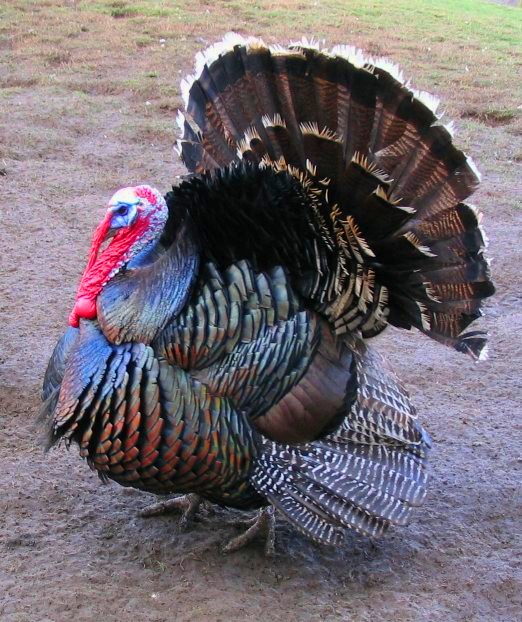
Photo: photo taken by Lupin on en:Wikipedia · CC BY-SA 3.0
A fast-growing commercial meat turkey with the bronze-sheened plumage of the Standard Bronze but the broad-breasted body of a modern hybrid. Like the BBW it usually cannot breed naturally.
ℹ️
Educational only. KinStation content is reviewed by licensed veterinarians but cannot replace an in-person exam. Always consult a licensed veterinarian or board-certified specialist for diagnosis, treatment, or any decision affecting your pet's health.
🩺 Need expert help with your broad breasted bronze?
Connect with a specialist near you or ask a licensed vet — never substitute online guidance for hands-on care in an emergency.
From the minimum an animal needs to be kept humanely, up to the ideal setup. Bigger is almost always better — minimums are floors, not targets.
Photo coming soon
Minimum
Production turkey shelter + run
8 sq ft shelter + 15 sq ft run per bird
Broad Breasted Bronze are commercial production turkeys (toms 38 lb, hens 22 lb in 18 wk). They CANNOT mate naturally (chest in the way); breeders use artificial insemination. Provide 8 sq ft shelter, 15 sq ft run, low roost (≤ 1 ft — leg joints fail under heavy bodies), shade, and constant water.
Photo coming soon
Recommended
Pasture with shade + low roosts
10 sq ft shelter + 50 sq ft pasture per bird, ground roosts
Open shelter with low roost beams and a fenced 50 sq ft pasture per bird with shade trees or shade cloth. Their oversized breast and rapid growth predispose them to leg failure, heat stress, and heart failure — keep activity moderate, water cool, no high jumps.
Photo coming soon
Ideal
Pasture-raised short-life production
Free-range pasture + shaded barn, 18–22 wk life cycle
Free-range pasture rearing with shade and a deep-bedded barn. Broad Breasted Bronzes are bred for meat at 18–22 wk; older birds (>1 yr) frequently develop crippling lameness and heart problems. Welfare-conscious keepers slaughter on schedule and don't keep them as long-term pets.
Life & growth stages
How this animal changes through its life — each stage often has its own care, diet and space needs.
Photo coming soon
Egg
Birds develop inside a hard-shelled egg incubated by the parent(s). Egg size, shell color, and clutch size vary by species; the embryo develops over days to weeks before hatching.
Photo coming soon
Hatchling / Chick
Hatchlings are either altricial — naked, blind, and dependent on parents (typical of parrots and songbirds) — or precocial — downy, mobile, and self-feeding soon after hatching (typical of poultry and waterfowl). Down gives way to the first feathers.
Photo coming soon
Juvenile / Fledgling
Fledglings grow in their juvenile plumage and begin to fly and feed themselves, though they may still beg from parents at first. Juvenile feathering is often duller than the adult and is replaced as the bird matures.
Adult
Adults attain full body size and mature plumage, and are capable of breeding. Many species show distinct adult coloration, and in sexually dimorphic birds males and females differ in plumage, size, or markings.
(c) Eric Schmidt, some rights reserved (CC BY) via iNaturalist — https://www.inaturalist.org/observations/93649779
Habitat & enclosure
Coop or barn with covered run, 4-6+ sq ft floor space per adult on dry litter. Dark feathers leave dark pinfeather stubs on the dressed carcass, a cosmetic downside versus white birds, but they tolerate sun better. Too heavy for high roosting; use low or no roosts and non-slip footing. Provide shade and good ventilation.
Diet
Commercial turkey starter (~28% protein) for poults, then grower and finisher rations; large appetite and rapid growth. Free-choice grit and constant fresh water. In heat, ensure cool water and shade. Breeders held past market age may need feed restriction to limit weight gain and protect legs.
Behavior & temperament
Docile and heavy-bodied, raised as a meat (broad-breasted) bird and typically processed around 16-20 weeks. The wide breast generally prevents natural mating, so most commercial production uses artificial insemination, though some lines retain limited fertility. A terminal-type hybrid rather than a self-sustaining heritage breed.
Health
Welfare note: shares the BBW's growth-related problems — leg/joint disorders, lameness, footpad dermatitis, breast blisters, heart strain, and heat stress. Dark pinfeathers complicate plucking. Longevity is short; birds kept past market age commonly become lame and obese. Reduced or absent natural fertility.
Tips, DIY & hacks
Keep bedding dry to avoid foot and breast lesions; provide shade and cooling in summer. Distinguish from the slow-growing Standard Bronze — the broad-breasted version grows much faster and cannot reliably self-reproduce. If retaining as pets, restrict feed and provide soft, level footing.