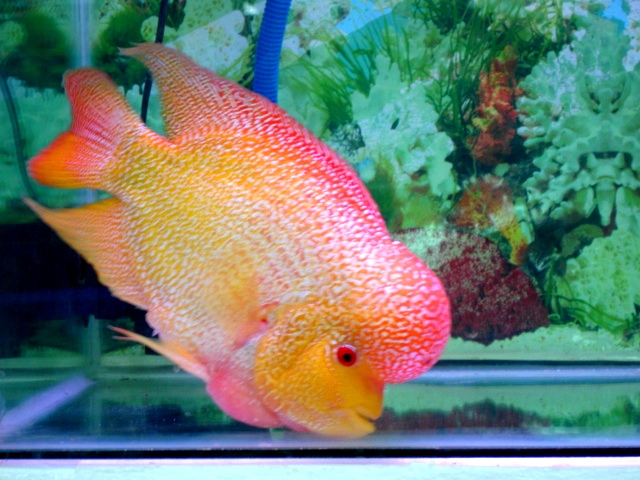
A man-made ornamental cichlid created by hybridizing several Central American cichlids (Amphilophus, Vieja, and Cichlasoma-group species), prized for its huge nuchal hump ('kok'), bold markings, and dog-like personality. It is hardy and interactive but large, aggressive, and an artificial hybrid that should never be released, as feral flowerhorns are invasive and their sale or possession is restricted or banned in parts of Australia, the US, and elsewhere.
ℹ️
Educational only. KinStation content is reviewed by licensed veterinarians but cannot replace an in-person exam. Always consult a licensed veterinarian or board-certified specialist for diagnosis, treatment, or any decision affecting your pet's health.
🩺 Need expert help with your flowerhorn cichlid?
Connect with a specialist near you or ask a licensed vet — never substitute online guidance for hands-on care in an emergency.
None in the wild; a captive-developed hybrid derived from Central American (Amphilophus/Vieja/Cichlasoma-group) cichlids
Origin
New World
Climate
🌴 Tropical
Water type
💧 Freshwater
Family
Cichlidae
Genus
Amphilophus
Part of the Cichlids
Cichlids are a large, behaviorally complex family of freshwater fish prized for color, intelligence, and elaborate parental care. They range from peaceful dwarfs to highly territorial Rift Lake and Central American species, and most demand stable water chemistry and thoughtful tankmate selection.
From the minimum an animal needs to be kept humanely, up to the ideal setup. Bigger is almost always better — minimums are floors, not targets.
Photo coming soon
Minimum
Single specimen tank
75 gal / 284 L long
Flowerhorn hybrids reach 12–16 in and are extremely aggressive. 75-gal long is a strict minimum for a single specimen (always solo). Strong filtration (massive waste), smooth décor, sand or bare-bottom, and enrichment.
Photo coming soon
Recommended
Adult display tank
125 gal / 473 L long
125-gal long for an adult with massive filtration, varied décor (rotate for enrichment), sand bed, and engagement (they recognise keepers). Always single.
Photo coming soon
Ideal
Show display tank
180 gal+ / 681 L+ display
180-gal+ show display with strong filtration, varied décor, enrichment toys, and lots of keeper interaction. Highly intelligent and personable when given space.
Life & growth stages
How this animal changes through its life — each stage often has its own care, diet and space needs.
Photo coming soon
Egg
Fish eggs are small, translucent spheres, often laid in clutches on plants, substrate, or in a nest — or carried/brooded by a parent in livebearing and mouth-brooding species. A dark eye spot and the curled embryo become visible inside as development progresses.
Photo coming soon
Fry
Newly hatched fry are tiny and semi-transparent, frequently still carrying a yolk sac that fuels them before they feed freely. They lack full fin structure and adult coloration, staying near cover until they can swim and forage on their own.
Photo coming soon
Juvenile
Juveniles look like miniature adults but with developing fins and muted or different markings; many species shift pattern and color as they mature. Growth is rapid at this stage given clean water and steady feeding.
Adult
Adults show the species' full size, finnage, and mature coloration, and are sexually mature. Many fish develop sex-specific differences in size, color, or fin shape, which can intensify during breeding.
Color & pattern variants
Natural variants occur in the wild; selectively bred (man-made) variants were developed in captivity.
Selectively bred (man-made)
representative
Zhen Zhu
A popular pearl-scaled flowerhorn strain with heavy white pearling, rounded body, and a tendency toward large water-based humps; relatively easy to breed and color up.
representative
Kamfa
A strain valued for a solid, often fatty 'kok' hump, sunken or white eyes, wrapped tail, and bold flowerline markings; generally rounder-bodied and more prized by enthusiasts.
representative
Golden Monkey (Kamalau)
A rare, highly sought red-gold strain historically commanding very high prices, known for intense coloration.
Habitat & enclosure
A single adult needs a large tank, ideally 250-340 L (65-90 gal) or more, with a long footprint and robust, secured decor since they rearrange everything. Most are kept in a bare or sparsely decorated tank to suit their digging and aggression. Maintain warm water at 26-30 C (79-86 F), pH 7.0-8.0, and moderate hardness. Strong, oversized filtration is essential because they are big, messy eaters that produce heavy waste loads.
Substrate
A bare bottom or a layer of smooth sand simplifies cleaning of their heavy waste and avoids injury from constant digging. If using substrate, keep decor minimal and well-anchored, as flowerhorns relentlessly excavate and topple ornaments.
Equipment & setup
Use heavily oversized filtration (large canister and/or sump rated well above tank volume) to cope with their waste. A reliable heater, secure tight lid, and shatter-resistant or thick glass are recommended given their size and strength. No UVB or special lighting is needed; standard lighting that displays their colors is sufficient.
Diet
An omnivore leaning carnivorous. Feed a staple of high-quality cichlid pellets formulated for color and hump growth, supplemented with frozen and occasional live foods such as krill, shrimp, earthworms, and bloodworm. Avoid feeding raw mammalian meat (e.g. beef heart) as a staple, which can cause obesity and organ problems. Feed measured amounts one to three times daily and avoid overfeeding.
Behavior & temperament
Bold, intelligent, and notoriously aggressive, with strong territoriality toward other fish and even their own reflection. Most are kept singly because they will attack and often kill tankmates. They are highly interactive, recognizing and responding to their keeper, and may 'beg' or follow hands; some learn to be hand-fed, but their powerful jaws warrant caution. Not a community fish.
Health
Hardy and long-lived in clean, well-filtered water, but prone to obesity, bloat, and hole-in-the-head disease (often linked to poor diet, poor water quality, and possibly Hexamita). Heavy waste output makes large frequent water changes critical. Avoid nutrient-poor or overly fatty diets. Damage to the hump or fins can occur from glass-surfing and aggression.
Tips, DIY & hacks
Keep adults singly to avoid lethal aggression. Because flowerhorns are man-made hybrids with no natural range, NEVER release them or their water into the wild; feral flowerhorns are established invasives in several regions and their sale or possession is restricted or banned in some jurisdictions (for example parts of Australia and certain US states), so check local laws before acquiring one. Hump size and color are influenced by genetics, diet, and conditions, and a divider or mirror is sometimes used briefly to encourage 'kok' development, though prolonged provocation stresses the fish.