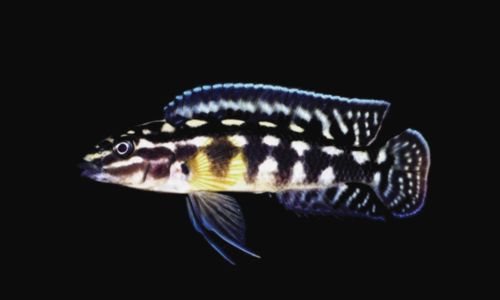
Photo: No machine-readable author provided. MiguelCampos assumed (based on copyright claims). · Public domain
Julidochromis marlieri is an elongate, rock-dwelling Tanganyikan cichlid patterned in a striking dark checkerboard. These bonded-pair cave spawners are intelligent, territorial, and rewarding for keepers who can provide a structured rocky aquascape.
ℹ️
Educational only. KinStation content is reviewed by licensed veterinarians but cannot replace an in-person exam. Always consult a licensed veterinarian or board-certified specialist for diagnosis, treatment, or any decision affecting your pet's health.
🩺 Need expert help with your julidochromis?
Connect with a specialist near you or ask a licensed vet — never substitute online guidance for hands-on care in an emergency.
Reaches about 13-15 cm (5-6 in), among the larger Julidochromis species; females typically larger than males.
Lifespan
5–10 years
Social needs
pair
Native region
Lake Tanganyika, East Africa (endemic)
Origin
Old World
Climate
🌴 Tropical
Water type
💧 Freshwater
Family
Cichlidae
Genus
Julidochromis
Part of the Cichlids
Cichlids are a large, behaviorally complex family of freshwater fish prized for color, intelligence, and elaborate parental care. They range from peaceful dwarfs to highly territorial Rift Lake and Central American species, and most demand stable water chemistry and thoughtful tankmate selection.
From the minimum an animal needs to be kept humanely, up to the ideal setup. Bigger is almost always better — minimums are floors, not targets.
Photo coming soon
Minimum
Pair rock tank
30 gal / 114 L rockscape
Julidochromis species reach 3–5 in and are Tanganyikan rock-dwellers. 30-gal minimum for a bonded pair, with massive rockwork (stable, on base plate), hard alkaline water (pH 8.0–9.0), and sand.
Photo coming soon
Recommended
Tanganyikan pair display
55 gal / 208 L rockscape
55-gal rockscape with a bonded pair, sand, hard alkaline water, and compatible Tanganyikan tankmates (shell-dwellers, peaceful Cyps). Excellent parental behaviour in caves.
Photo coming soon
Ideal
Tanganyikan biotope
75 gal+ / 284 L+ biotope
Lake Tanganyika rocky-shore biotope with massive rockwork, sand, hard alkaline water, and a stable pair plus compatible tankmates. Best parental display and territorial behaviour.
Life & growth stages
How this animal changes through its life — each stage often has its own care, diet and space needs.
Photo coming soon
Egg
Fish eggs are small, translucent spheres, often laid in clutches on plants, substrate, or in a nest — or carried/brooded by a parent in livebearing and mouth-brooding species. A dark eye spot and the curled embryo become visible inside as development progresses.
Photo coming soon
Fry
Newly hatched fry are tiny and semi-transparent, frequently still carrying a yolk sac that fuels them before they feed freely. They lack full fin structure and adult coloration, staying near cover until they can swim and forage on their own.
Photo coming soon
Juvenile
Juveniles look like miniature adults but with developing fins and muted or different markings; many species shift pattern and color as they mature. Growth is rapid at this stage given clean water and steady feeding.
Adult
Adults show the species' full size, finnage, and mature coloration, and are sexually mature. Many fish develop sex-specific differences in size, color, or fin shape, which can intensify during breeding.
Color & pattern variants
Natural variants occur in the wild; selectively bred (man-made) variants were developed in captivity.
Natural
representative
Regional checkerboard color forms
Different collection localities around Lake Tanganyika show variation in the intensity and arrangement of the dark checkerboard markings and base color, and keepers maintain locality lines separately.
Habitat & enclosure
A pair needs at least 110-150 L (30-40 gal) built as a rocky biotope with abundant stacked stone, crevices, and caves running from substrate to surface. Aquascape with vertical rock faces, as these fish hug and patrol rock surfaces. Water parameters: temperature 24-27 C (75-81 F), pH 8.0-9.0, hardness very high (GH 12-20, KH 12-18). They live among the rocky shorelines and steep walls of Lake Tanganyika.
Substrate
Fine aragonite or coral sand buffers the water and suits the biotope, though these fish spend most of their time on rock rather than digging. The most important structural element is heavy, stable rockwork: build caves and ledges directly on the base glass so the rock cannot shift as fish tunnel beneath.
Equipment & setup
Efficient filtration (canister or quality hang-on-back) to keep nitrate low, a reliable heater, and moderate flow. A secure lid prevents jumping. Lighting can be moderate to encourage some biofilm growth on rocks, which the fish graze. No specialty equipment beyond a stable, well-buffered hardwater system is required.
Diet
An omnivore feeding on aufwuchs (biofilm), small invertebrates, and zooplankton picked from rock surfaces in the wild. Provide a varied diet of quality cichlid pellet/flake, frozen mysis, brine shrimp, cyclops, and some spirulina or vegetable matter. Feed modest amounts; like other Tanganyikans they are prone to bloat from overfeeding rich protein.
Behavior & temperament
Forms strong monogamous pair bonds and is territorial around the chosen cave, especially when breeding; pairs can be aggressive toward intruders but are calm otherwise. Bonded pairs practice biparental cave spawning and may form colonies where older offspring help guard younger fry. Pairing can be tricky: incompatible adults may fight, so grow a group together to let a pair form, then remove extras. An observation fish, not handled.
Health
Hardy in stable hard alkaline water. Main risks are bloat from overfeeding, and injury from pairing-related aggression or being kept with overly boisterous tankmates. Maintain pristine water with regular changes and avoid protein-heavy or mammalian-fat foods. Quarantine new fish and watch for ich and parasites under stress.
Tips, DIY & hacks
To get a compatible pair, raise six or more juveniles together and remove all but the bonded pair once they claim a cave. Provide more caves than pairs if attempting a colony. Avoid housing two Julidochromis species together, as they may hybridize. Keep with peaceful Tanganyikan tankmates that occupy different zones, such as open-water Cyprichromis.