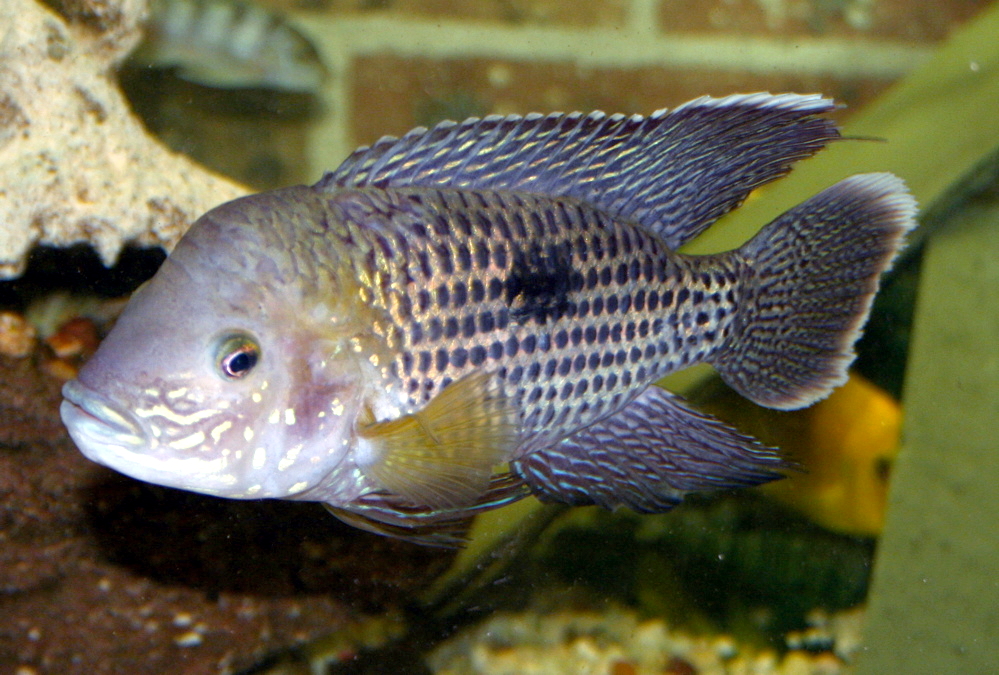
A striking metallic blue-green New World cichlid named for its often pugnacious temperament. It is colorful and personable but territorial and best suited to keepers with a large tank and some cichlid experience.
ℹ️
Educational only. KinStation content is reviewed by licensed veterinarians but cannot replace an in-person exam. Always consult a licensed veterinarian or board-certified specialist for diagnosis, treatment, or any decision affecting your pet's health.
🩺 Need expert help with your green terror?
Connect with a specialist near you or ask a licensed vet — never substitute online guidance for hands-on care in an emergency.
Large; males reach 8-12 in (20-30 cm), females a bit smaller, with mature males developing a pronounced nuchal hump.
Lifespan
7–10 years
Social needs
solo
Native region
Pacific drainages of western Ecuador and Peru, South America
Origin
New World
Climate
🌴 Tropical
Water type
💧 Freshwater
Family
Cichlidae
Genus
Andinoacara
Part of the Cichlids
Cichlids are a large, behaviorally complex family of freshwater fish prized for color, intelligence, and elaborate parental care. They range from peaceful dwarfs to highly territorial Rift Lake and Central American species, and most demand stable water chemistry and thoughtful tankmate selection.
From the minimum an animal needs to be kept humanely, up to the ideal setup. Bigger is almost always better — minimums are floors, not targets.
Photo coming soon
Minimum
Pair tank
75 gal / 284 L long
Andinoacara rivulatus reaches 8–10 in and is aggressive. 75-gal long minimum for a bonded pair, with sand, smooth rockwork, driftwood, and strong filtration. Single specimens or pairs only — no other cichlids.
Photo coming soon
Recommended
Display pair tank
125 gal / 473 L long
125-gal long for a pair with tough tankmates (large peaceful catfish), sand, smooth rockwork, and strong filtration. Stunning electric green/blue colour in mature pairs.
Photo coming soon
Ideal
South American biotope
180 gal+ / 681 L+ biotope
South American biotope with sand, driftwood, rockwork, and a pair plus compatible tankmates. Best colour and parental behaviour in stable mature setups.
Life & growth stages
How this animal changes through its life — each stage often has its own care, diet and space needs.
Photo coming soon
Egg
Fish eggs are small, translucent spheres, often laid in clutches on plants, substrate, or in a nest — or carried/brooded by a parent in livebearing and mouth-brooding species. A dark eye spot and the curled embryo become visible inside as development progresses.
Photo coming soon
Fry
Newly hatched fry are tiny and semi-transparent, frequently still carrying a yolk sac that fuels them before they feed freely. They lack full fin structure and adult coloration, staying near cover until they can swim and forage on their own.
Photo coming soon
Juvenile
Juveniles look like miniature adults but with developing fins and muted or different markings; many species shift pattern and color as they mature. Growth is rapid at this stage given clean water and steady feeding.
Adult
Adults show the species' full size, finnage, and mature coloration, and are sexually mature. Many fish develop sex-specific differences in size, color, or fin shape, which can intensify during breeding.
Color & pattern variants
Natural variants occur in the wild; selectively bred (man-made) variants were developed in captivity.
Natural
representative
Gold saum
A regional form with a bright orange to red edge (saum) on the dorsal and tail fins, widely traded and often what hobbyists picture as the 'green terror.'
representative
Silver saum
A form with white to silver fin edging rather than orange, originating from Peruvian populations; some authorities regard these as the separate species Andinoacara stalsbergi rather than a color form of A. rivulatus.
Habitat & enclosure
House a single adult or a bonded pair in at least a 75-gallon (285 L) tank; 125 gallons is better for a pair or any tankmates, with a footprint that allows territory separation. Provide rockwork, driftwood, and a few caves while leaving open swimming space. Keep water at 70-77F (21-25C), pH 6.5-8.0, and soft to moderately hard water; they tolerate a wide range. A tight-fitting lid is wise as cichlids can jump. Use robust decor as they may rearrange substrate and uproot plants.
Substrate
Use fine sand or smooth rounded gravel; they sift and dig substrate, especially when preparing to spawn. Sand is gentler and lets natural sifting behavior occur. Anchor or weight any plants and decor, as they will move loose items.
Equipment & setup
Provide an oversized canister or large hang-on-back filter (or both) for heavy biological load and good flow. Use a reliable heater set to the mid-70s F and a secure lid. No special lighting is needed; moderate light suits the fish and any hardy plants. A gravel vacuum and test kit for ammonia, nitrite, and nitrate support the required weekly water changes.
Diet
An opportunistic omnivore leaning carnivorous. Feed a quality cichlid pellet as the staple, supplemented with frozen or live foods such as bloodworms, brine shrimp, krill, earthworms, and chopped seafood, plus occasional vegetable matter like blanched peas or spirulina. Feed adults once or twice daily in amounts consumed in a couple of minutes. Avoid feeding mammalian meats like beef heart as a staple; the fat is poorly digested.
Behavior & temperament
Aggressive and highly territorial, especially when breeding, which is the origin of the name. A male can dominate or kill smaller or weaker fish, so tankmates must be similarly large, robust cichlids or fast catfish, and the tank must be big enough to spread out aggression. Often kept as a single specimen or a proven pair. They are intelligent, recognize their keeper, and show strong personality. Not a community fish.
Health
Hardy when water quality is maintained, but sensitive to the nitrate and ammonia spikes their heavy waste load can cause, so strong filtration and weekly water changes are essential. Watch for head-and-lateral-line erosion (HLLE), often linked to poor diet or water quality, plus ich and bloat from overfeeding. Quarantine new fish and feed a varied diet to prevent deficiencies.
Tips, DIY & hacks
Buy several juveniles and let a pair form naturally if you want to breed, then rehome the others before aggression escalates. Sex by the rounded extended fins and brighter color of mature males. Rearranging decor when adding a new tankmate can reset territories and reduce bullying. The 'gold saum' (orange fin edge) and 'silver/white saum' forms reflect different regional populations; note that the Peruvian silver-saum fish is considered by some authorities to be a separate species (Andinoacara stalsbergi), the 'true' green terror, so wild-origin stock can be a complex of closely related forms.