KinStation
Sign inSign up
← Encyclopedia
🐟 AquaticCare difficulty: IntermediateLegal complexity: Low

Green terror

Andinoacara rivulatus · also called Green terror cichlid, Gold saum, Silver saum, Aequidens rivulatus, Andinoacara rivulatus
⚖️ Compare
Green terror

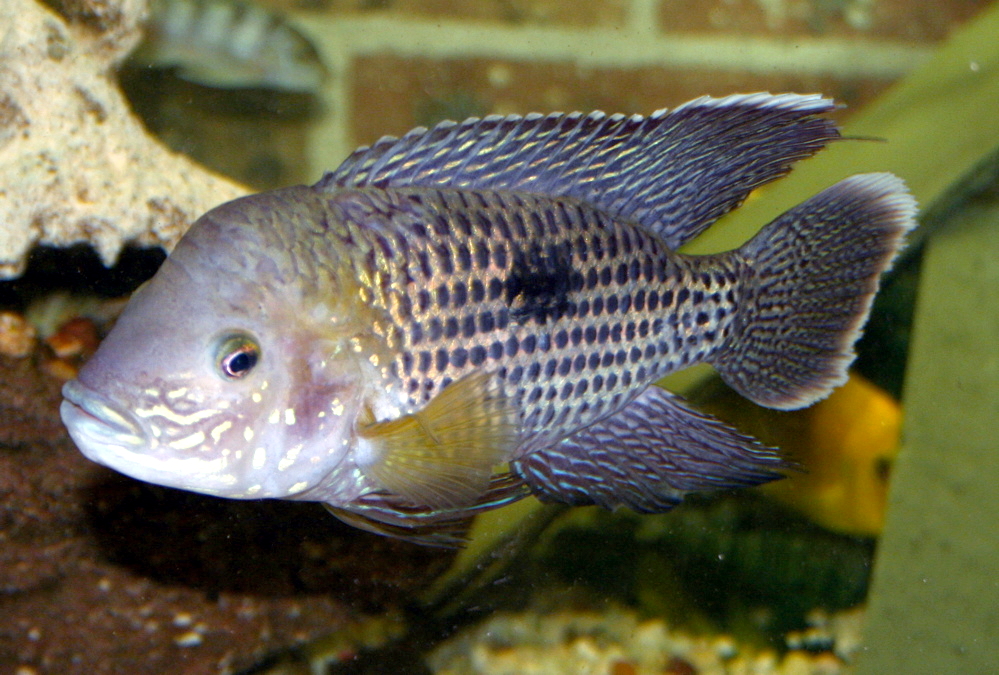
A dazzling South American cichlid shimmering with metallic blue-green scales and an iridescent face mask; mature males develop a fatty nuchal hump. The name fits — they are beautiful but genuinely feisty, suiting keepers ready for a large, territorial centerpiece fish.

Educational only. KinStation content is reviewed by licensed veterinarians but cannot replace an in-person exam. Always consult a licensed veterinarian or board-certified specialist for diagnosis, treatment, or any decision affecting your pet's health.

🩺 Need expert help with your green terror?

Connect with a specialist near you or ask a licensed vet — never substitute online guidance for hands-on care in an emergency.

💬 Ask a vet in the community

Quick facts

SizeMales to about 8-12 in (20-30 cm); females smaller, around 6-7 in (15-18 cm).
Lifespan7–10 years
Social needspair
Native regionSouth America (Pacific-slope rivers of Ecuador and Peru)
OriginNew World
Climate🌴 Tropical
Water type💧 Freshwater
FamilyCichlidae
GenusAndinoacara

Part of the Cichlids

Cichlids are a large, behaviorally complex family of freshwater fish prized for color, intelligence, and elaborate parental care. They range from peaceful dwarfs to highly territorial Rift Lake and Central American species, and most demand stable water chemistry and thoughtful tankmate selection.

Blood parrot cichlidConvict cichlidDiscusElectric yellow cichlidFiremouth cichlidFlowerhorn cichlidFreshwater angelfishFrontosaGerman blue ramGreen terrorJack DempseyJack Dempsey cichlidJulidochromisKribensis+5 more →

Habitat & space requirements

From the minimum an animal needs to be kept humanely, up to the ideal setup. Bigger is almost always better — minimums are floors, not targets.

Photo coming soon
Minimum

Pair tank

75 gal / 284 L long

Andinoacara rivulatus reaches 8–10 in and is aggressive. 75-gal long minimum for a bonded pair, with sand, smooth rockwork, driftwood, and strong filtration. Single specimens or pairs only — no other cichlids.

Photo coming soon
Recommended

Display pair tank

125 gal / 473 L long

125-gal long for a pair with tough tankmates (large peaceful catfish), sand, smooth rockwork, and strong filtration. Stunning electric green/blue colour in mature pairs.

Photo coming soon
Ideal

South American biotope

180 gal+ / 681 L+ biotope

South American biotope with sand, driftwood, rockwork, and a pair plus compatible tankmates. Best colour and parental behaviour in stable mature setups.

Life & growth stages

How this animal changes through its life — each stage often has its own care, diet and space needs.

Photo coming soon
Egg

Fish eggs are small, translucent spheres, often laid in clutches on plants, substrate, or in a nest — or carried/brooded by a parent in livebearing and mouth-brooding species. A dark eye spot and the curled embryo become visible inside as development progresses.

Photo coming soon
Fry

Newly hatched fry are tiny and semi-transparent, frequently still carrying a yolk sac that fuels them before they feed freely. They lack full fin structure and adult coloration, staying near cover until they can swim and forage on their own.

Photo coming soon
Juvenile

Juveniles look like miniature adults but with developing fins and muted or different markings; many species shift pattern and color as they mature. Growth is rapid at this stage given clean water and steady feeding.

Adult stage
Adult

Adults show the species' full size, finnage, and mature coloration, and are sexually mature. Many fish develop sex-specific differences in size, color, or fin shape, which can intensify during breeding.

Color & pattern variants

Natural variants occur in the wild; selectively bred (man-made) variants were developed in captivity.

Natural
Gold saumrepresentative

Gold saum

Trade form showing an orange-to-gold edging ('saum') on the dorsal and tail fins; often the strain seen in the hobby.

Silver / white saumrepresentative

Silver / white saum

Form with a white-to-silver fin margin rather than orange; associated with the true Andinoacara rivulatus from Ecuador.

Wild-type (silver saum)representative

Wild-type (silver saum)

CommonIntermediate

A metallic blue-green body speckled with electric scales; the wild Pacific-drainage form edges its fins in a white-to-silver band (the 'silver saum').

Tip: A genuinely territorial fish that grows large and digs — give a long tank, robust filtration, and tankmates too big to swallow but not rivals for territory.

Gold saum / Orange-edgerepresentative

Gold saum / Orange-edge

CommonIntermediate

A geographic/line form (often traded as the true green terror) whose dorsal and tail fins are rimmed with a bright orange-red band instead of white.

Tip: Same demanding temperament as the silver form; the orange edging intensifies with age, good color, and a varied carotenoid-rich diet.

Selectively bred (man-made)
Electric blue / Neonrepresentative

Electric blue / Neon

UncommonIntermediate

A selectively-bred line that floods the whole body with intense turquoise-blue, reducing the dark facial striping for a near-uniform glowing look.

Tip: Just as territorial as standard green terrors despite the showy color — don't let the looks tempt you into a peaceful community tank.

Albino / Goldrepresentative

Albino / Gold

UncommonIntermediate

An amelanistic strain showing a pale gold-to-white body with red eyes, with the fin band and facial speckling reduced to soft pastel tones.

Tip: Provide shaded areas for the light-sensitive red eyes; aggression and adult size are unchanged from the wild-type, so plan tank space accordingly.

Habitat & enclosure

A single fish needs at least 55 gallons (about 200 L); pairs or community setups need 75-125 gallons (285-475 L) with a long footprint. Keep temperatures at 68-77°F (20-25°C), pH 6.5-8.0, and soft to moderately hard water. They are notably tolerant of cooler temperatures than many tropical cichlids. Provide robust rockwork, driftwood, and caves to define territories and break up lines of sight. Moderate flow and standard lighting work well; a darker background and substrate accentuate their electric blue-green sheen.

Substrate

Fine sand or smooth rounded gravel suits their digging and sifting habits. Anchor rock and wood structures on the base glass, since they excavate vigorously around spawning sites; a darker substrate deepens their iridescent color.

Equipment & setup

Run an oversized canister or large hang-on-back filter to manage their substantial bioload, paired with a heater guard. Standard aquarium lighting is fine. Moderate flow and disciplined weekly water changes are the cornerstone of keeping them healthy and colorful.

Diet

Green terrors are carnivorous to omnivorous. Feed a staple of quality cichlid pellets, supplemented with frozen or live bloodworms, krill, shrimp, and earthworms, plus occasional vegetable matter. Avoid live feeder fish, which risk introducing disease. Feed adults once daily and juveniles more often, in modest portions. A varied, color-enhancing diet supports their vivid metallic coloration.

Behavior & temperament

Aggressive and territorial, living up to the 'terror' name — especially mature males and breeding pairs. Best kept singly, as an established pair, or with similarly sized robust cichlids and large catfish in a spacious tank with plenty of cover. Not suitable for small, slow, or peaceful tankmates. Intelligent and interactive, they recognize their keeper and become bold. Pairs are substrate-spawners and protective parents, intensifying in aggression when guarding fry.

Health

Hardy when water is clean and stable, but prone to hole-in-the-head/HLLE under poor water quality or nutritional deficiency, and to ich during stress or temperature swings. Their heavy waste output makes nitrate control via strong filtration and frequent water changes essential.

Tips, DIY & hacks

Confirm which strain you are buying — 'gold saum' (Andinoacara stalsbergi types, orange fin edge) and 'silver/white saum' forms differ in trade names and origin. Grow out a group to form a bonded pair, then remove the others, and over-filter to keep these messy eaters' water pristine.

Sources

  1. Green terror — Wikipedia (wikipedia)
  2. Andinoacara rivulatus (Green Terror) — Seriously Fish (care guide)
  3. Wikipedia: Green terror (wiki)