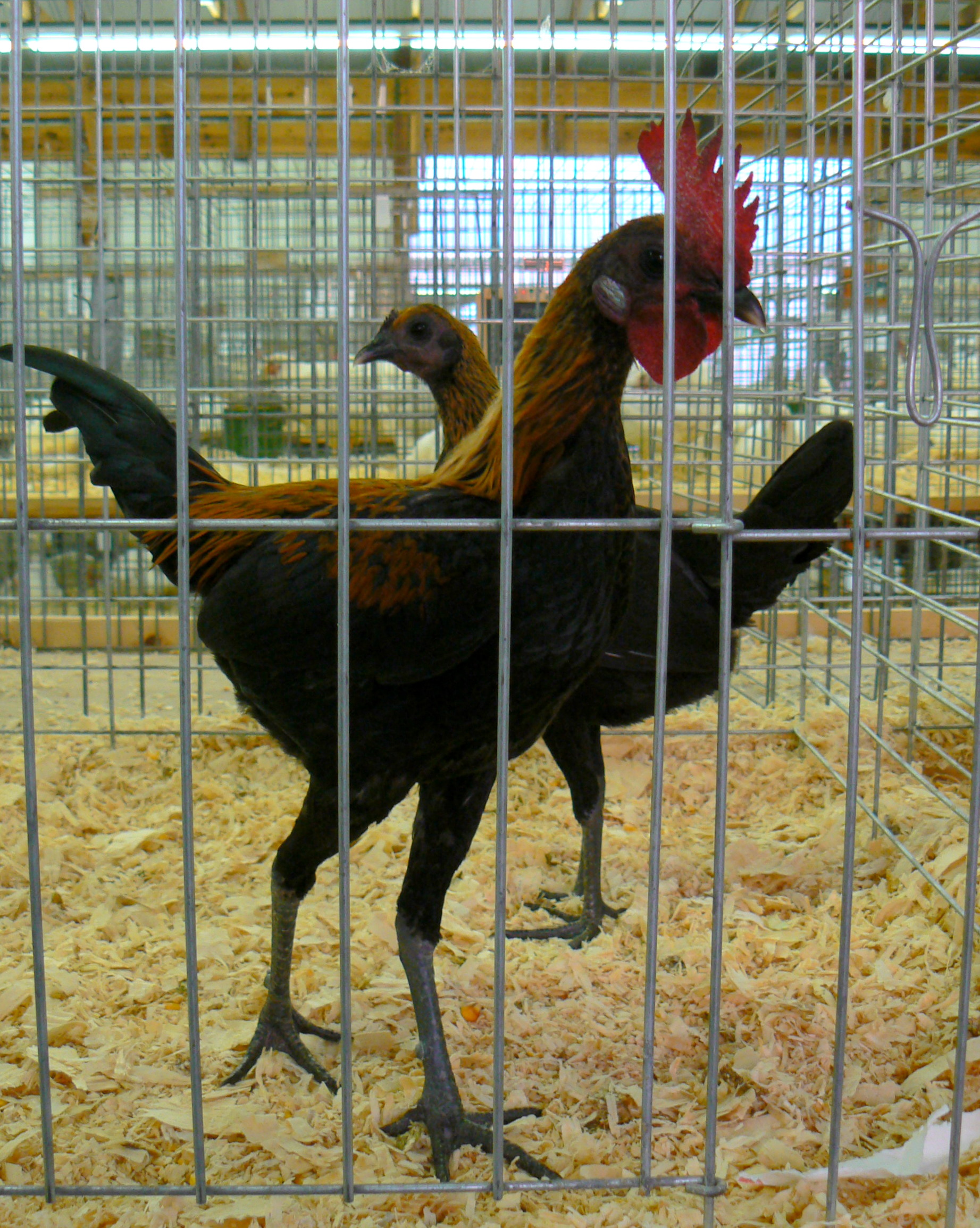
A purely ornamental exhibition breed developed in Victorian England after cockfighting was banned, prized for an extremely tall, elegant, hard-feathered 'racehorse' conformation. Almost always kept as a bantam.
ℹ️
Educational only. KinStation content is reviewed by licensed veterinarians but cannot replace an in-person exam. Always consult a licensed veterinarian or board-certified specialist for diagnosis, treatment, or any decision affecting your pet's health.
🩺 Need expert help with your modern game?
Connect with a specialist near you or ask a licensed vet — never substitute online guidance for hands-on care in an emergency.
From the minimum an animal needs to be kept humanely, up to the ideal setup. Bigger is almost always better — minimums are floors, not targets.
Photo coming soon
Minimum
Tall coop + fenced run
4 sq ft coop + 12 sq ft run / bird
Modern Game are slim, upright, long-legged ornamental chickens (24+ in tall) bred for show stance. A welfare minimum is 4 sq ft of coop with ≥ 5 ft headroom and 12 sq ft of covered run per bird, with strong low perches, broad nest boxes, grit, calcium, clean water, and predator-proof ¼ in hardware cloth.
Photo coming soon
Recommended
Tall coop + display run
6 sq ft coop + 15 sq ft run / bird
A 6 sq ft per bird tall coop with a 15+ sq ft per bird covered run lets Modern Game stride, court, and condition for show. Single-male pens during breeding season, dust-bath, deep soft litter for the long legs, and shaded perches keep show plumage in condition.
Photo coming soon
Ideal
Show-fancier covered aviary
8 sq ft coop + 20 sq ft covered run / bird
An 8 sq ft per bird coop with a 20+ sq ft per bird fully roofed display aviary delivers prime show condition for this English exhibition breed. Sand floor protects feet, single-male pens prevent fights, and skylight panels let the iridescent plumage show without rain exposure.
Life & growth stages
How this animal changes through its life — each stage often has its own care, diet and space needs.
Photo coming soon
Egg
Birds develop inside a hard-shelled egg incubated by the parent(s). Egg size, shell color, and clutch size vary by species; the embryo develops over days to weeks before hatching.
Photo coming soon
Hatchling / Chick
Hatchlings are either altricial — naked, blind, and dependent on parents (typical of parrots and songbirds) — or precocial — downy, mobile, and self-feeding soon after hatching (typical of poultry and waterfowl). Down gives way to the first feathers.
Photo coming soon
Juvenile / Fledgling
Fledglings grow in their juvenile plumage and begin to fly and feed themselves, though they may still beg from parents at first. Juvenile feathering is often duller than the adult and is replaced as the bird matures.
Adult
Adults attain full body size and mature plumage, and are capable of breeding. Many species show distinct adult coloration, and in sexually dimorphic birds males and females differ in plumage, size, or markings.
(c) D. N., some rights reserved (CC BY-NC) via iNaturalist — https://www.inaturalist.org/observations/312084723
Color & pattern variants
Natural variants occur in the wild; selectively bred (man-made) variants were developed in captivity.
Provide a snug, well-insulated, draft-free coop — their tight 'hard' feathering and minimal fluff offer little insulation, so they are sensitive to cold and wet. A covered run keeps them dry. They are tame and tolerate confinement well. In cold climates supplementary warmth or careful winter housing is advisable; their large single combs are frostbite-prone.
Diet
Standard balanced poultry diet (grower then layer) with grit and calcium free-choice. They have modest appetites for their frame. Ensure adequate protein for feather and muscle. No special dietary needs beyond keeping condition on a lean, leggy bird.
Behavior & temperament
Purpose: exhibition/show only — kept for their striking conformation, not production. Hens lay a small number of tiny cream/tinted eggs and seldom go broody. Temperament is exceptionally friendly, calm and people-oriented, making them good show birds and pets that tame readily.
Health
Cold-sensitivity is the key welfare issue: sparse hard feathering and large combs predispose to frostbite and chilling. The exaggerated long legs are a deliberate conformation trait — select for sound, straight legs and avoid extremes that impair movement. Otherwise generally healthy.
Tips, DIY & hacks
Keep in dry, warm housing through winter and watch combs in frost (a little petroleum jelly helps). Their tameness means they handle well for showing — accustom birds young to posing. Not a self-reliant free-ranger; better suited to managed pens. Source from exhibition breeders for correct type.