 KinStation
 Aquatic
St Thomas mushroom
Rhodactis osculifera · also called St. Thomas mushroom, Warty corallimorph, Discosoma sanctithomae, Rhodactis sanctithomae
 Compare
Called the warty corallimorph in the field, this Caribbean mushroom has a flat disc bumpy with wart-shaped tentacles that split into forks at the tip. Moderate light and low to moderate flow suit it, as they do most corallimorphs, and hobby forms are chosen for brightly coloured warts. Older names such as Discosoma or Rhodactis sanctithomae are still common, but Rhodactis osculifera is the accepted name today. It damages corals it can reach, so keep a clear gap between it and stony corals, and allow for its spread into mats.

Need expert help with your st thomas mushroom?
 Need expert help with your st thomas mushroom?
Connect with a specialist near you or ask a licensed vet — never substitute online guidance for hands-on care in an emergency.
 Ask a vet in the community
Quick facts
| Size | Flattened disc up to about 9 cm across; one field guide gives 2-8 cm. |
| Lifespan | — |
| Social needs | solo |
| Native region | Florida, the Bahamas and the Caribbean |
| Origin | New World |
| Climate | Tropical |
| Water type | Marine |
| Family | Discosomidae |
| Genus | Rhodactis |
 Tropical
 Marine
Part of the Mushroom Corals
Soft, disc-shaped corallimorphs (Rhodactis, Discosoma, Ricordea, and bounce morphs) that carpet rockwork in fluorescent colors. Hardy, low-light, low-flow, and among the best beginner reef invertebrates.
Color & pattern variants
Natural variants occur in the wild; selectively bred (man-made) variants were developed in captivity.
Yellow St Thomas Mushroom →
Named for its yellow warts.
Purple St Thomas Mushroom →
Named for its purple warts.
Strawberry and Cream St Thomas Mushroom →
A hobby colour name that points to red and pale tones. No fuller description is on record.
Orange Cream St Thomas Mushroom →
A hobby colour name that points to orange and pale tones. No fuller description is on record.
Red St Thomas Mushroom →
A vivid green disc almost buried under red-orange forked warts, thickest toward the rim. Near the centre the green shows through, with a few grey-mauve warts around a lilac mouth.
Orange St Thomas Mushroom →
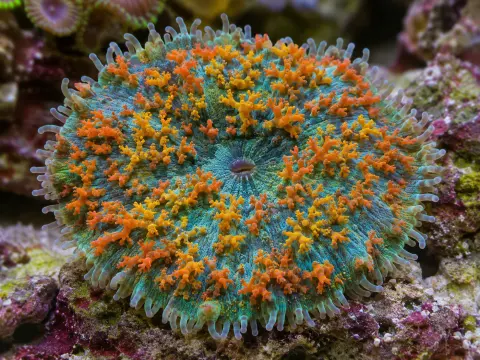
A green disc with pale radial streaks, dotted with forked tufts in golden yellow to amber orange. The tufts sit further apart than on the red form, so more of the green shows, and the raised mouth is mauve.
 representative
St. Thomas Mushroom →
A forked-tentacle mushroom sold for years as a Discosoma and now placed in Rhodactis. It has a cool blue or green base topped with bright branching growths in warm colours or white.
Habitat & enclosure
Substrate
Equipment & setup
Diet
Behavior & temperament
Health
Tips, DIY & hacks
Sources
- Rhodactis osculifera, World Register of Marine Species (web)
- Discosoma sanctithomae, World Register of Marine Species (web)
- Rhodactis osculifera, Dutch Caribbean Species Register (web)
- Warty Corallimorph, Caribbean Reefs guide (web)
- Inducible Agonistic Structures in the Tropical Corallimorpharian, Discosoma sanctithomae, The Biological Bulletin (web)
- Rhodactis osculifera, DORIS, FFESSM (web)