Clove Polyps
Clavularia viridis · also called Glove Polyps, Fern Polyps, Clavularia, Eight-Tentacle Polyps, Palm Tree Polyps

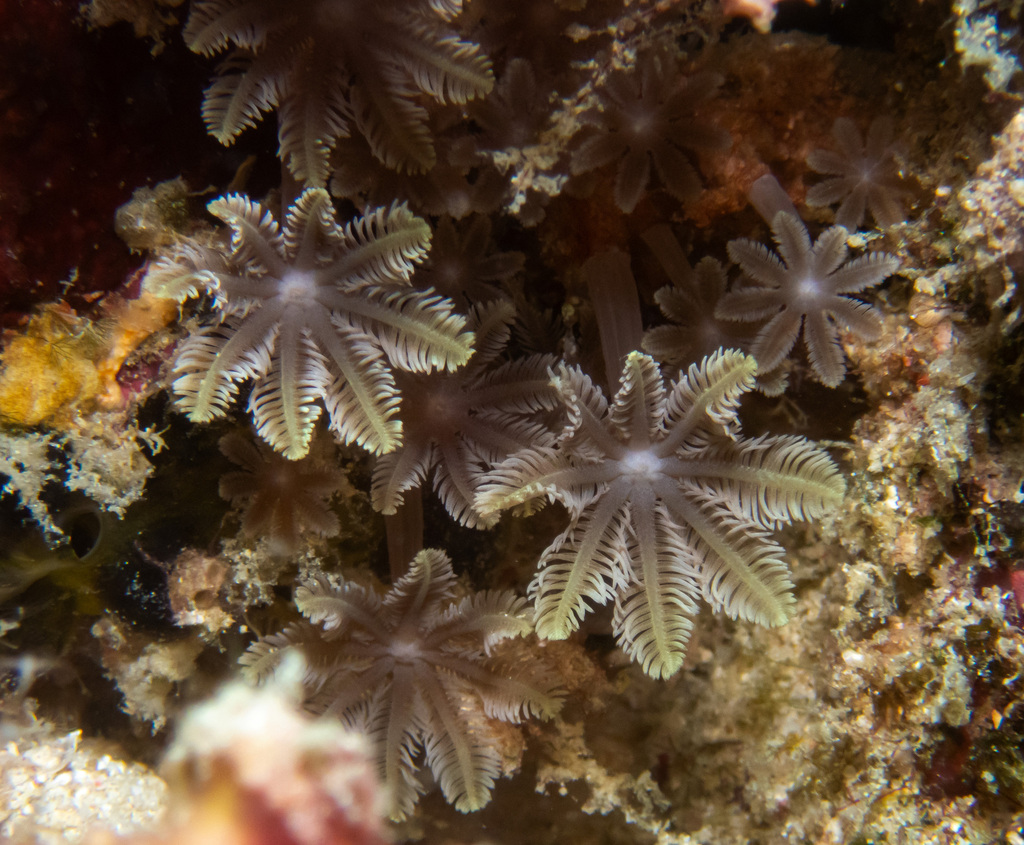
A colonial soft coral that forms spreading mats of star-shaped, eight-tentacled polyps connected by a thin encrusting stolon, often glowing neon green under blue light. Extremely easy and fast-spreading, it is a classic starter coral that can become invasive within the tank.
🩺 Need expert help with your clove polyps?
Connect with a specialist near you or ask a licensed vet — never substitute online guidance for hands-on care in an emergency.
Quick facts
| Size | Individual polyps ~1-2.5 cm with feathery eight-tentacle crowns; mats spread indefinitely across rock |
| Lifespan | 5–20 years |
| Social needs | group |
| Native region | Indo-Pacific reefs, including Indonesia, the Philippines, and the western Pacific |
| Origin | Old World |
| Climate | 🌴 Tropical |
| Water type | 🌊 Marine |
| Family | Clavulariidae |
| Genus | Clavularia |
Part of the Soft Corals
Soft corals such as leathers, colt, cloves, Anthelia, gorgonians and Sympodium. Non-skeletal octocorals with flexible, often swaying colonies and eight-tentacled polyps; mostly hardy, beginner-friendly reef corals driven by photosynthesis and tolerant of a wide range of light, flow and nutrients.
Habitat & space requirements
From the minimum an animal needs to be kept humanely, up to the ideal setup. Bigger is almost always better — minimums are floors, not targets.
Life & growth stages
How this animal changes through its life — each stage often has its own care, diet and space needs.
Color & pattern variants
Natural variants occur in the wild; selectively bred (man-made) variants were developed in captivity.
 representative
Neon Green Clove Polyps
The most common form, with brilliant fluorescent-green tentacles that light up under blue LEDs.
 representative
Brown/Tan Clove Polyps
A more subdued tan to brown wild form, often even faster spreading than the colored morphs.
 representative
Drove/Daisy Clove variants
Trade names for closely related Clavularia/Knopia clove forms with slightly larger or more feathery polyps.
representativeGreen Clove Polyp (Neon Green / Daisy Polyp) →
The classic clove: eight feathery tentacles per polyp resembling a daisy, with a neon-green coloration that fluoresces under blue light.
Tip: Very forgiving; moderate light and moderate flow on rock, where it will quickly carpet the surface into a dense mat. Keep it away from prized neighbors, as it encrusts and can overgrow them.
 representative
WWC Fireworks Clove Polyp →
One of the most colorful soft corals: bright orange-tipped purple feathery tentacles flaring around a bright green center, giving a literal 'fireworks' burst when fully open.
Tip: Place on rock or a frag plug under moderate reef lighting (roughly 150-250 PAR) with moderate flow. Cloves color up and extend their feathery polyps best when flow is brisk enough to keep detritus off but not so strong that the polyps stay retracted. Fast-growing, so leave a buffer from neighboring corals.
representativeWWC Flame Tipped Clove Polyp →
A fast-growing soft coral with bluish-purple polyps capped by bright yellow-orange tips, like a flame on each feathery tentacle.
Tip: Give it moderate light and moderate flow; it spreads quickly across rock, so leave a buffer zone from neighboring corals. Polyps extend best when current keeps detritus moving without blasting them shut.
representativeWWC Florida Squeeze Clove Polyp →
Purple feathery polyps with neon orange tips in a citrusy color combination that gives it the 'Florida Squeeze' name.
Tip: Moderate light with moderate flow on a rock face or plug works well; cloves grow in spreading clusters and send out baby polyps from the base, so plan for spread.
representativeWWC High Voltage Clove Polyps →
High-saturation clove polyps with vivid neon coloration that pops under blue-spectrum reef lighting.
Tip: Moderate light and moderate flow; under a blue-leaning spectrum the neon pigments stand out. A mid-tank rock with steady current suits it well.
representativeWWC Lemon Tipped Clove Polyps →
Feathery clove polyps with bright lemon-yellow tips fading into a darker body, creating a clean two-tone look across the mat.
Tip: Moderate flow and moderate light; this morph is forgiving and spreads readily across rock, making it a good shaded-edge filler. Keep faster neighbors from shading it out.
representativeTSA Firework Clove Polyp →
A vivid clove morph with a green mouth fading into orange tentacles capped by blue tips, sold as a Top Shelf Aquatics signature piece.
Tip: Mount in a moderate-flow, moderate-light zone (around 50-150 PAR); blue-spectrum lighting brings out the fluorescent highlights. Avoid high-flow areas, which make the polyps retract.
representativeTSA Lemon Laser Clove Polyp →
Vivid lemon-yellow polyps with a teal mouth, bright yellow striping and blue tentacle tips that appear to glow under reef lighting.
Tip: Moderate light (about 50-150 PAR) and moderate, indirect flow; the yellow stays brightest under a blue-leaning spectrum and when the colony isn't shaded by faster-growing neighbors.
representativeTSA Candy Corn Clove Polyp →
A yellow-and-orange clove morph evoking candy corn, with warm autumn-toned feathery polyps.
Tip: Place in moderate, indirect flow with moderate light; the warm orange and yellow tones hold best under a strong blue spectrum. Cloves spread across rock quickly, so give it room from prized neighbors.
representativeTSA Candied Pumpkin Clove Polyp →
A warm pumpkin-orange clove morph with pulsing feathery polyps, named for its candied-orange tone.
Tip: Moderate light and moderate, indirect flow on a rock face will keep the warm orange pigment saturated; a blue-leaning spectrum enhances the color.
representativeJason Fox Yellow Infused Rainbow Clove Polyps →
A rainbow clove morph with extra yellow infusion through the tentacles, layering yellow over the multicolor green/orange/violet clove base.
Tip: Medium light with low-to-moderate flow; the multicolor pigments hold best under a moderate blue-leaning spectrum without being blasted by current.
representativeJason Fox Orange Infused Rainbow Clove Polyps →
A rainbow clove with heavy orange infusion, pushing warm orange through the multicolor feathery polyps.
Tip: Medium light and low-to-moderate flow; keep it off direct high flow so the polyps fully extend and display the orange saturation.
representativeAquaSD Rainbow Fireworks Clove Polyps →
A rainbow 'fireworks' clove showing purple feathery polyps with bright green centers and neon orange tips across a pulsing carpet.
Tip: Moderate light and moderate flow on a rock face or frag rack; this morph forms dense, fast-growing mats, so plan for spread.