Pulsing xenia
Xenia sp. · also called Pulse coral, Pom-pom xenia, Pulsing pom-pom coral

Photo: No machine-readable author provided. Haplochromis assumed (based on copyright claims). · Public domain
Pulsing xenia is a mesmerizing soft coral whose feathery polyps rhythmically open and close like tiny grasping hands — a behavior unique among corals. It is hardy and absurdly fast-growing, making it a fascinating beginner coral that just as often becomes an invasive weed.
🩺 Need expert help with your pulsing xenia?
Connect with a specialist near you or ask a licensed vet — never substitute online guidance for hands-on care in an emergency.
Quick facts
| Size | Colony of stalked polyps each topped with feathery pinnate tentacles; individual polyps ~2-5 cm, colonies spreading indefinitely. |
| Lifespan | 5–50 years |
| Social needs | solo |
| Native region | Indo-Pacific |
| Origin | Old World |
| Climate | 🌴 Tropical |
| Water type | 🌊 Marine |
| Family | Xeniidae |
| Genus | Xenia |
Part of the Soft Corals
Soft corals such as leathers, colt, cloves, Anthelia, gorgonians and Sympodium. Non-skeletal octocorals with flexible, often swaying colonies and eight-tentacled polyps; mostly hardy, beginner-friendly reef corals driven by photosynthesis and tolerant of a wide range of light, flow and nutrients.
Habitat & space requirements
From the minimum an animal needs to be kept humanely, up to the ideal setup. Bigger is almost always better — minimums are floors, not targets.
Life & growth stages
How this animal changes through its life — each stage often has its own care, diet and space needs.
Color & pattern variants
Natural variants occur in the wild; selectively bred (man-made) variants were developed in captivity.
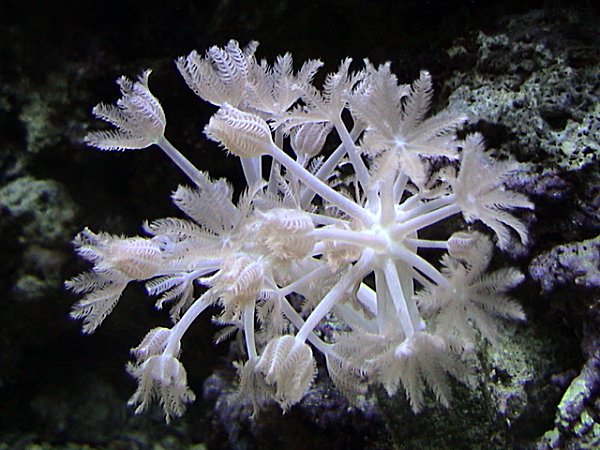 representative
Pom-pom (pulsing) xenia →
The classic cream-to-tan form with feathery polyps that continuously pulse open and closed.
 representative
Silver/blue tip xenia →
A form with a silvery or bluish sheen on the polyp tips, prized for its shimmer under LED light.

Red Sea xenia (Xenia umbellata) →
Larger-polyped strong-pulsing form often collected from the Red Sea region.
 representative
Silver / White Pulsing Xenia →
A silvery-white to pale form that pulses strongly; among the most vigorous and commonly traded xenias.
Tip: If pulsing stops, raise nutrients slightly or increase flow; in a too-clean tank xenia often quits pulsing or even melts.
 representative
Pink / Red Sea Xenia →
A pink-tinged Red Sea pulsing xenia, slightly more colorful than the standard tan form.
Tip: Keep it on a frag island surrounded by bare sand — xenia spreads by walking, and an isolated rock is the only reliable way to contain it.
 representative
Blue / Neon Xenia →
A blue-toned or neon-tinted pulsing xenia that fluoresces under actinic light.
Tip: Run heavier blue spectrum to bring out the tint; it still pulses best with moderate flow, so aim a gentle stream past (not at) the polyps.
 representative
Giant / Drooping Xenia (Anthelia-type) →
Taller, larger-polyped 'giant' or non-pulsing drooping xenia (often Anthelia), with longer stalks that may or may not pulse.
Tip: Anthelia-type xenia encrusts the rock and is even harder to remove than pulsing xenia — never put it on your main aquascape unless you want it everywhere.
 representative
Sustained-Pulse Red Sea Xenia →
Selected Red Sea lines marketed for constant, strong pulsing action even in display conditions.
Tip: Stable alkalinity and a touch of nutrients keep the pulse going; sudden water-change swings are the most common reason a strong-pulsing colony abruptly stops.
 representative
Pom Pom Xenia (Pulsing Xenia) →
The classic cream-to-tan pulsing xenia whose feathery polyps rhythmically open and close like grasping hands. The hypnotic pulsing motion, not color, is the draw.
Tip: Glue a frag to an isolated rock or island away from the main scape — xenia spreads aggressively and is hard to remove once established; moderate flow and light encourage stronger pulsing.
 representative
Silver Tip / Blue Xenia (Heteroxenia) →
A xenia variant with silvery-white or pale-blue polyp tips contrasting against tan or pinkish stalks, giving a frosted look while it pulses.
Tip: Place mid-to-high on a dedicated rock under moderate light; like all xenia, keep it isolated to contain its rapid spread.
 representative
Red Sea Pulsing Xenia →
The classic pulsing xenia of the hobby, with cream-to-tan feathery polyps on tall stalks that rhythmically open and close like tiny grasping hands. Colors run from off-white and silver to lavender-cream depending on lighting.
Tip: Place on its own isolated rock or frag plug with moderate flow and medium light (~100-150 PAR); it spreads aggressively, so keep it off your main aquascape.
 representative
Pink / Purple Xenia →
A xenia displaying pink to lavender-purple stalk and polyp coloration rather than the usual tan, a common-to-uncommon pigment variant in the genus.
Tip: Moderate light and flow on an isolated rock; coloration can fade if conditions shift, so keep lighting consistent.
 representative
Silver Branch Pulsing Xenia (Xenia elongata) →
A long-stalked Xenia elongata form with silvery-tan branches and bright pulsing polyp heads, often sold as 'Silver Tip' or 'Silver Branch' for its pale, shimmering stalks. Taller and more tree-like than the stubby pom-pom types.
Tip: Give it moderate flow to keep detritus off the long stalks; it will rapidly colonize glass and rock, so dedicate an island rock to it.
 representative
Pom Pom Xenia →
Short, compact stalks topped with rounded clusters of pinkish-tan polyps that pulse quickly, giving a busy 'pom-pom' look rather than the tall waving stalks of standard xenia. Often shows a faint bluish or pink cast under blue light.
Tip: Tolerates higher light and flow than tall xenia; mount on a dedicated rock since it carpets surfaces fast.
 representative
Blue Cespitularia (Blue Xenia) →
A Cespitularia-genus 'blue xenia' (a close xenia relative, not a true Xenia) with shimmering powder-blue to violet stalks and contrasting pale polyps, far more colorful than ordinary tan xenia.
Tip: Less forgiving than true Xenia: keep very stable nutrients, strong-ish flow and brighter light to hold the blue, and avoid sudden parameter swings that cause it to melt.
 representative
Red Xenia →
An unusual non-pulsing Xenia with reddish-purple coloration and noticeably thicker stalks that branch higher up, forming dense clumps instead of a waving carpet. Distinct from the standard pulsing forms in both color and motion.
Tip: Because it does not pulse and stays clumpier, it is less invasive than pulsing xenia, but still give it moderate light and flow on its own rock.