Toadstool leather coral
Sarcophyton sp. · also called Toadstool coral, Leather coral, Mushroom leather coral, Sarco
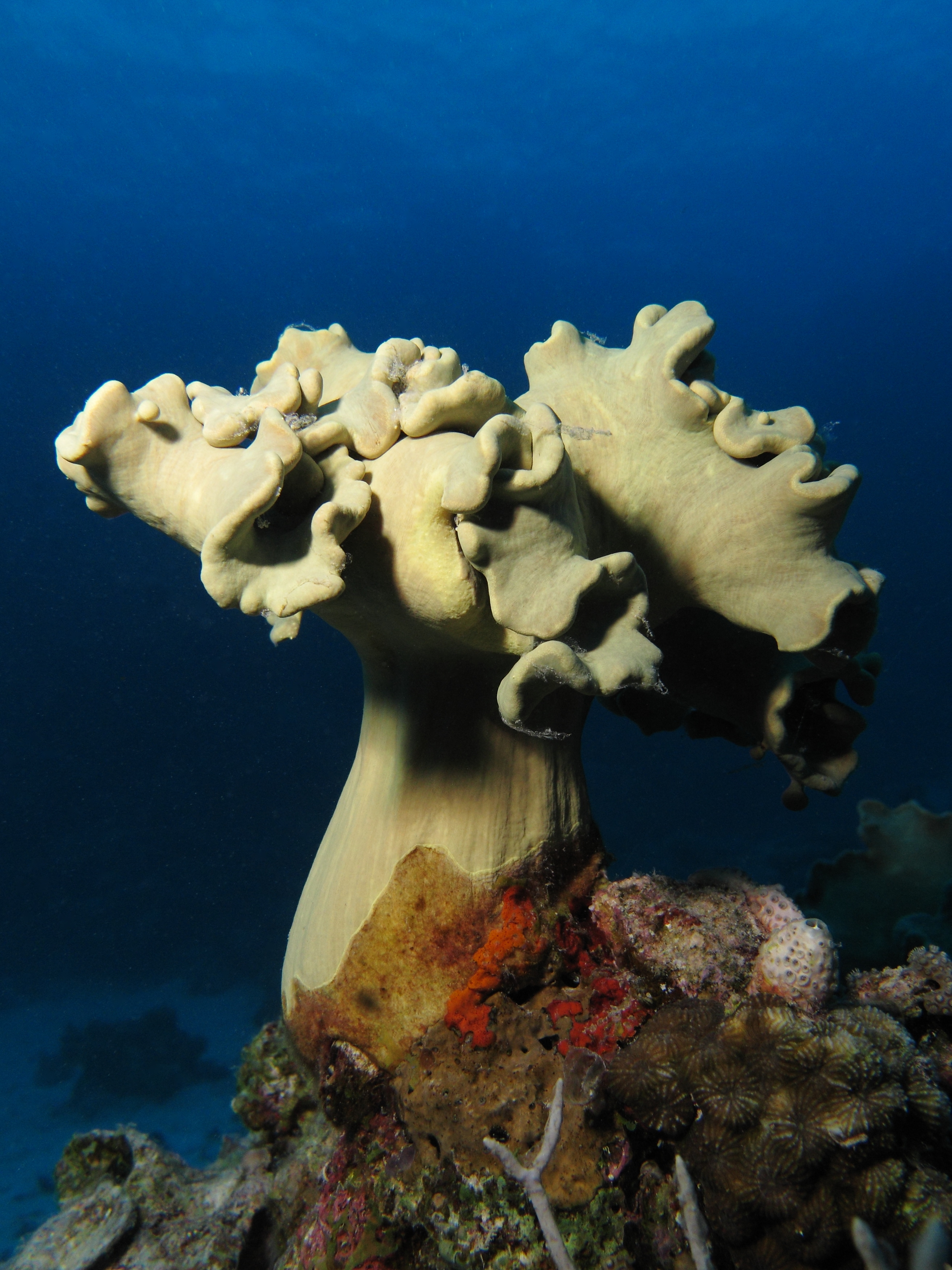
The toadstool leather is a classic, beginner-friendly soft coral shaped like a wide mushroom cap on a thick stalk. It is hardy and forgiving, periodically sheds a waxy film to clean itself, and grows into an impressive centerpiece while gently chemically defending its space.
🩺 Need expert help with your toadstool leather coral?
Connect with a specialist near you or ask a licensed vet — never substitute online guidance for hands-on care in an emergency.
Quick facts
| Size | Mushroom-shaped colony with a stalk and broad capitulum; commonly 10-30 cm across, large specimens exceeding 50 cm. |
| Lifespan | 10–75 years |
| Social needs | solo |
| Native region | Indo-Pacific |
| Origin | Old World |
| Climate | 🌴 Tropical |
| Water type | 🌊 Marine |
| Family | Alcyoniidae |
| Genus | Sarcophyton |
Part of the Soft Corals
Soft corals such as leathers, colt, cloves, Anthelia, gorgonians and Sympodium. Non-skeletal octocorals with flexible, often swaying colonies and eight-tentacled polyps; mostly hardy, beginner-friendly reef corals driven by photosynthesis and tolerant of a wide range of light, flow and nutrients.
Habitat & space requirements
From the minimum an animal needs to be kept humanely, up to the ideal setup. Bigger is almost always better — minimums are floors, not targets.
Life & growth stages
How this animal changes through its life — each stage often has its own care, diet and space needs.
Color & pattern variants
Natural variants occur in the wild; selectively bred (man-made) variants were developed in captivity.
 representative
Green polyp toadstool →
The classic hobby toadstool: a tan-to-beige leathery mushroom cap studded with green to neon-green polyps that extend into a fuzzy crown when happy. The polyp green pops hardest under blue/actinic light.
Tip: Place low-to-mid on the rockwork in low-to-moderate light and gentle-to-moderate flow; periodic strong flow helps it shed its waxy coat and prevents detritus buildup on the cap. Run carbon, as toadstools release terpenes that can chemically irritate close neighbors.
 representative
Yellow Fiji leather (Sarcophyton elegans) →
A true yellow-bodied leather from Fiji, far more demanding than the common tan toadstool and prone to melting if conditions slip.
Tip: Needs strong, stable lighting and pristine water to hold the yellow; it is notoriously sensitive on import, so quarantine and acclimate slowly.
 representative
Green Toadstool →
The classic *Sarcophyton* with a tan-to-cream cap and green fluorescing polyps. One of the most forgiving beginner softies.
Tip: Place in low-to-moderate light and gentle flow; expect periodic 'shedding' of a waxy film as it sloughs detritus — don't mistake it for dying.
 representative
Toxic Green Toadstool →
A toadstool leather with a flat-to-ruffled cap in a vivid neon 'toxic' green, its short polyps studding the cap and waving in flow.
Tip: Place it in low-to-moderate light and moderate flow on a rock where it has room to expand; expect periodic shedding of a waxy film (normal self-cleaning) and don't bother it during the closed/shed phase.
 representative
Neon/Green Polyp Toadstool →
Tan cap with densely packed bright green polyps that give a 'grassy' look when fully extended.
Tip: Give it room to expand — the cap can triple in width when happy; provide moderate flow so polyps extend fully.
 representative
Spaghetti / Long-Polyp Toadstool →
A form (often *Sarcophyton* with very long, stringy polyps) that drapes flowing tentacles, giving a hairy, flowing appearance.
Tip: Use gentle, indirect flow so the long polyps sway rather than being blasted flat; allow open space as it can sting nearby corals.
 representative
Red/Maroon Toadstool →
Uncommon reddish to maroon-capped leather, valued for the unusual body color among mostly tan toadstools.
Tip: Keep nutrients moderate (not ultra-low) — overly stripped water can fade the reddish body toward tan.
 representative
Devil's Hand Leather (Lobophytum) →
A finger-lobed leather often sold alongside toadstools; the cap forms thick digit-like projections rather than a smooth mushroom cap.
Tip: Hardy and undemanding — give moderate flow to keep detritus off the lobes; it also benefits from a weekly slough cycle, so don't be alarmed when it closes up.
 representative
Weeping Willow Toadstool →
A long-polyp *Sarcophyton* whose supple polyp stalks can grow several inches and droop over the cap when flow stops, giving the unmistakable 'weeping willow' silhouette; the body is typically a pinkish-brown.
Tip: To develop the signature long polyps it wants strong, randomized alternating flow and good light; keepers have famously grown it like an SPS coral with high light, high flow and clean water.
 representative
Yellow Fiji Toadstool →
A toadstool with a creamy-yellow to golden cap and pale extended polyps, the classic 'golden' Fiji leather look that brightens a tank with warm tones.
Tip: Moderate light brings out the yellow tone; give moderate flow and space on the rockwork, and allow normal periodic shedding without disturbing it.
representativeGreen Polyp / Neon Toadstool →
A tan-to-brown capped toadstool whose polyps glow bright fluorescent green under blue light, creating a striking 'starry' green-polyp effect across the mushroom cap.
Tip: Use blue-spectrum lighting to maximize the green polyp fluorescence, keep light low-to-moderate to encourage full polyp extension, and provide moderate flow with room to expand.
representativeYellow Fiji Toadstool (Sarcophyton elegans) →
A genuinely yellow leather, ranging from pale beige-yellow to vivid banana/golden-yellow, with a heavily frilled, undulated crown and numerous fine extending polyps. The color is natural (not dyed) and is uncommon among leathers.
Tip: Much more demanding than other toadstools: it behaves more like an SPS coral, needing high light and high flow plus stable, clean water to hold its yellow color. It is sensitive to shipping and acclimation, so drip-acclimate slowly and treat it as a delicate specimen, not a hardy beginner softie.
representativeJapanese Toadstool (Neon Green) →
A neon-green toadstool strain in which both the capitulum and the polyps glow green under blue light, traded as the 'Japanese' toadstool. A colorful step up from the plain brown toadstool while staying hardy.
Tip: Provide moderate flow and good blue-spectrum light to maximize the green; give it space and run carbon, as leathers can chemically suppress nearby corals during their periodic mucus shed.
representativeToxic Green Weeping Willow Toadstool →
A neon/'toxic' green long-polyp toadstool in which both the cap and the very long willowy polyps glow green, so the extended polyps can be mistaken for a torch or other *Euphyllia*. Combines the 'Japanese' green coloration with weeping-willow polyp length.
Tip: Provide moderate-to-strong, varied flow to let the long polyps stream out and good blue-spectrum light to maximize the green; space it well from other corals, as leathers can chemically suppress neighbors.
representativeWhite Tip Toadstool →
A toadstool color form with a pinkish body and polyp stalks that terminate in snow-white tips, giving a two-tone, speckled crown when fully extended.
Tip: Keep it in modest light and moderate-to-strong flow so the polyps extend fully to show the white tips; like all leathers, give space and run carbon during its periodic mucus shed.
representativeTyree Green Toadstool →
An aquacultured green-polyp toadstool line offered under the 'Tyree' label, valued by keepers for an unusually saturated, even neon-green polyp color over a clean tan cap. Sellers describe it as brighter than generic green-polyp stock.
Tip: Give it moderate light to keep the green vivid (excess light can brown the cap) with intermittent strong flow; it is hardy, tolerates elevated nitrate/phosphate, and fragments readily once established.
representativeORA Neon Green Polyp Toadstool →
ORA's nursery-grown neon-green-polyp line, with a long-stalked beige mushroom cap and bright green polyps that fluoresce under blue light. A tank-adapted, fast-growing, hardy starter coral.
Tip: An ideal beginner placement coral: low-to-medium light and moderate flow anywhere on the rock; keep carbon running, as toadstools shed a mucus layer and release toxins that can suppress close neighbors.
representativeORA Lemon Lime Toadstool →
An ORA aquacultured toadstool selected for a bright yellow-green ('lemon lime') cast across the cap with green polyps, giving a more colorful look than the standard brown toadstool. A hardy, fast-growing softie.
Tip: Keep it under low-to-moderate light and moderate flow; like all leathers it periodically sheds a waxy film, so intermittent stronger flow and running carbon help it stay clean and limit chemical irritation of neighbors.
representativeCornbred's Japanese Blue Tip Toadstool →
A named Japanese-type long-polyp toadstool selected for green polyps tipped in blue, marketed as a 'blue tip' weeping-willow-style toadstool. The blue tipping on streaming polyps is its distinguishing feature.
Tip: Give it good blue-spectrum light to bring out the tip color and moderate-to-strong varied flow to let the long polyps extend; provide space and run carbon for the leather's periodic mucus shed.
representativeBIOTA White Polyp Toadstool →
A captive-bred toadstool with a beige base and green tentacles capped in white tips; young colonies show a convex center that flattens or becomes concave with age. The white-tipped polyps give it a clean, frosted look.
Tip: Hardy and beginner-friendly under medium light and medium-to-high flow; as a tank-bred coral it adapts quickly, but still give it space and run carbon for the leather's mucus shed.