KinStation
Menu
← Encyclopedia
AquaticCare difficulty: AdvancedLegal complexity: Low

Haddon's carpet anemone

Stichodactyla haddoni · also called Saddle anemone, Saddle carpet anemone, Haddoni carpet anemone

Compare

A big carpet anemone of Indo-West Pacific sand flats, its wide disc thrown into saddle-shaped folds and covered with short, round tentacles. Keepers need strong light, frequent meaty meals, open sand and lots of space, and it is among the best-known homes for clownfish. The sting is extremely powerful: corals, other anemones and any fish other than a clownfish can all be hurt, and a fish that touches it may not survive. It can also harm people, with a published case of anaphylactic shock.

Educational only. Some KinStation entries are reviewed by licensed veterinarians, but none can replace an in-person exam. Always consult a licensed veterinarian or board-certified specialist for diagnosis, treatment, or any decision affecting your pet's health.

Need expert help with your haddon's carpet anemone?

Connect with a specialist near you or ask a licensed vet — never substitute online guidance for hands-on care in an emergency.

Ask a vet in the community

Quick facts

SizeBroad, deeply folded disc, usually about 40-50 cm across when open and reported up to 75-80 cm.
Lifespan—
Social needssolo
Native regionIndo-West Pacific, from the Red Sea to Fiji
OriginOld World
Climate Tropical
Water type Marine
FamilyStichodactylidae
GenusStichodactyla

Part of the Sea Anemones

Stinging, sessile cnidarians ranging from clownfish-hosting giants to nano-sized carpet species. Many are demanding, mobile, and can sting corals or be drawn into pumps — careful placement and rock-stable water are essential.

Beaded sea anemoneBubble tip anemoneCarpet anemoneChristmas anemoneCondy anemoneHell's fire anemoneHemprich's sea anemoneLong tentacle anemoneMagnificent anemoneMertens' carpet anemoneMini Maxi AnemonePizza anemoneRock flower anemoneSebae Anemone+2 more →

Color & pattern variants

Natural variants occur in the wild; selectively bred (man-made) variants were developed in captivity.

Natural

Mint Haddoni →

Named for its mint green colour.

Neon Green Haddoni →

Named for its bright neon green colour.

Purple Haddoni →

Named for its purple colour.

Pink Haddoni →

Named for its pink colour.

Ruby Red Haddoni →

Named for its deep ruby red colour.

Orange Haddoni →

Named for its orange colour.

Peppermint Haddoni →

A hobby colour name. No fuller description is on record.

Blue Haddoni Carpet Anemone →

Ultra-rareAdvanced

A Haddon's carpet with deep saddle folds covered in short round tentacles of periwinkle blue. Plum flecks sit between the beads, and the area around the tan mouth fades to a pale, nearly bare blue-white.

Green Haddoni Carpet Anemone →

UncommonAdvanced

Thick folded ridges packed with short beads, teal along the crests and sage green down in the hollows. A few white beads are scattered through, and the insides of the folds show a rusty pink.

Lemon Lime Haddoni Carpet Anemone →

RareAdvanced

A broad, flat Haddon's carpet with mint-lime beads edged by a pinkish grey rim. The signature is a vivid lemon-yellow starburst that radiates from the mouth across the inner disc.
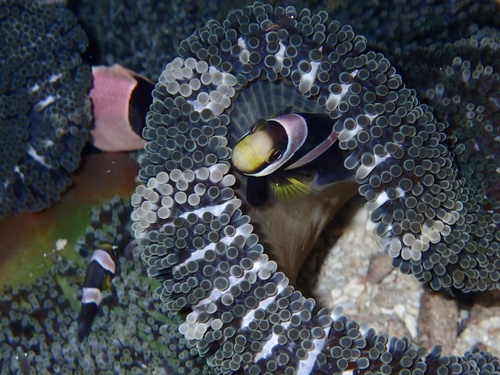
Haddoni / Saddle Carpet Anemone (Stichodactyla haddoni)

Haddoni / Saddle Carpet Anemone (Stichodactyla haddoni) →

CommonAdvanced

The related saddle carpet — a thick, deeply folded oral disc with shorter, beaded tentacles often in green, blue, purple or mottled 'saddle' patterning, sitting flat and broad on the sand.

Tip: Unlike gigantea it buries its foot deep in soft sand rather than anchoring to rock, so give it 4+ inches of sandbed and high light; its sting is potent and it readily eats fish, so choose tankmates carefully.

Habitat & enclosure

Give it strong light, moderate flow and a wide stretch of open sand well away from other animals. In the wild it lives on sand, among seagrass and on coral rubble from the Red Sea to Fiji, with the long column buried and the foot anchored below the surface. A fully grown animal needs a very large tank. Keep stable reef water: SG about 1.025, 24-27 °C (75-81 °F), pH 8.1-8.4, with steady salinity and low nutrients.

Substrate

Provide a deep, open sand bed that can take the long buried column. Do not try to fix it to rock.

Equipment & setup

Use strong reef lighting and moderate flow. Guard pump intakes, because this animal can move. Run a capable protein skimmer, since regular meaty feeds add nutrients.

Diet

Relies on light and on food. It keeps zooxanthellae that share what they make, so strong lighting is essential, and it also catches prey with its tentacles. Offer pieces of fish or shrimp regularly. Several feeds a week is the figure given for a related carpet, S. mertensii, and it is borrowed here.

Behavior & temperament

The tentacles are sticky and catch passing animals, and the disc can contract to hold prey before it reaches the mouth. Fish and crabs have been swallowed this way. Wild animals nearly always have anemonefish with them, and anemone shrimps and the three-spot dascyllus may join them. It can uproot itself and move, probably to avoid being buried by shifting sand.

Health

Can seriously harm people. Contact often causes only local irritation or welts, but one published case describes a 24-year-old man who got hives on first contact with S. haddoni, then breathing difficulty, severe hives and low blood pressure after exposure to water holding dead animals. Wear gloves, keep broken skin out of the water, take extra care with water from a dead or dying carpet, and get emergency care for breathing trouble, widespread hives or faintness. Very potent sting. Corals, other anemones and any fish other than a clownfish can all be harmed, and the sticky tentacles can hold prey fast. Loss of colour points to bleaching, and a shrinking, slack animal needs attention at once. If a large anemone dies, remove it quickly, because it can foul the water.

Tips, DIY & hacks

Give it a wide gap from every neighbour, and allow for its full spread when you plan the tank. Never count on a fish other than a clownfish surviving contact, and do not assume a clownfish will take to it right away. Never handle it bare-handed, and treat water from a dead carpet with care.

Sources

  1. Stichodactyla haddoni, World Register of Marine Species (web)
  2. Haddon's carpet anemone, WildSingapore (web)
  3. Carpet anemones, WildSingapore (web)
  4. Stichodactyla mertensii care, Saltcorner Aquarium Library (web)
  5. Anaphylactic Shock Caused by Exposure to Sea Anemones, Allergology International (web)