Zoanthids
Zoanthus sp. · also called Zoas, Zoa, Button polyps, Sea mats, Palys (for Palythoa)

Zoanthids are colonial polyps famous for their kaleidoscopic color morphs, which drive an entire naming-and-collecting hobby within the reef trade. They are hardy, fast-spreading beginner corals — but many contain palytoxin, one of the most potent natural toxins, so they must be handled with care.
🩺 Need expert help with your zoanthids?
Connect with a specialist near you or ask a licensed vet — never substitute online guidance for hands-on care in an emergency.
Quick facts
| Size | Small colonial polyps, typically 5-15 mm across, forming spreading mats of dozens to hundreds of polyps. |
| Lifespan | 5–50 years |
| Social needs | solo |
| Native region | Indo-Pacific |
| Origin | Old World |
| Climate | 🌴 Tropical |
| Water type | 🌊 Marine |
| Family | Zoanthidae |
| Genus | Zoanthus |
Part of the Soft Corals
Soft corals such as leathers, colt, cloves, Anthelia, gorgonians and Sympodium. Non-skeletal octocorals with flexible, often swaying colonies and eight-tentacled polyps; mostly hardy, beginner-friendly reef corals driven by photosynthesis and tolerant of a wide range of light, flow and nutrients.
Habitat & space requirements
From the minimum an animal needs to be kept humanely, up to the ideal setup. Bigger is almost always better — minimums are floors, not targets.
Life & growth stages
How this animal changes through its life — each stage often has its own care, diet and space needs.
Color & pattern variants
Natural variants occur in the wild; selectively bred (man-made) variants were developed in captivity.
 representative
Fruit Loops →
Bright orange tentacles over a ring of purple and a large ring of green on the face, looking like the cereal it's named for. A bold, high-contrast crowd favorite.
Tip: Place on mid rockwork under moderate light (PAR ~100-250) and moderate flow to keep the rings vivid; it is a reliable, fast spreader for newer reefers.
 representative
Utter Chaos →
A purple base splattered and swirled with yellow-green and accented by bright orange skirts. The disorganized multicolor look is exactly what gives it the name.
Tip: Very adaptable; place on mid rockwork under moderate light (PAR ~100-250) and moderate flow. Tends to spread quickly and can cover a plug, so give it room to grow.
representativeBrown/wild button polyps →
Plain brown or green wild-collected zoanthids, very hardy and inexpensive starter colonies.
 representative
Eagle Eye →
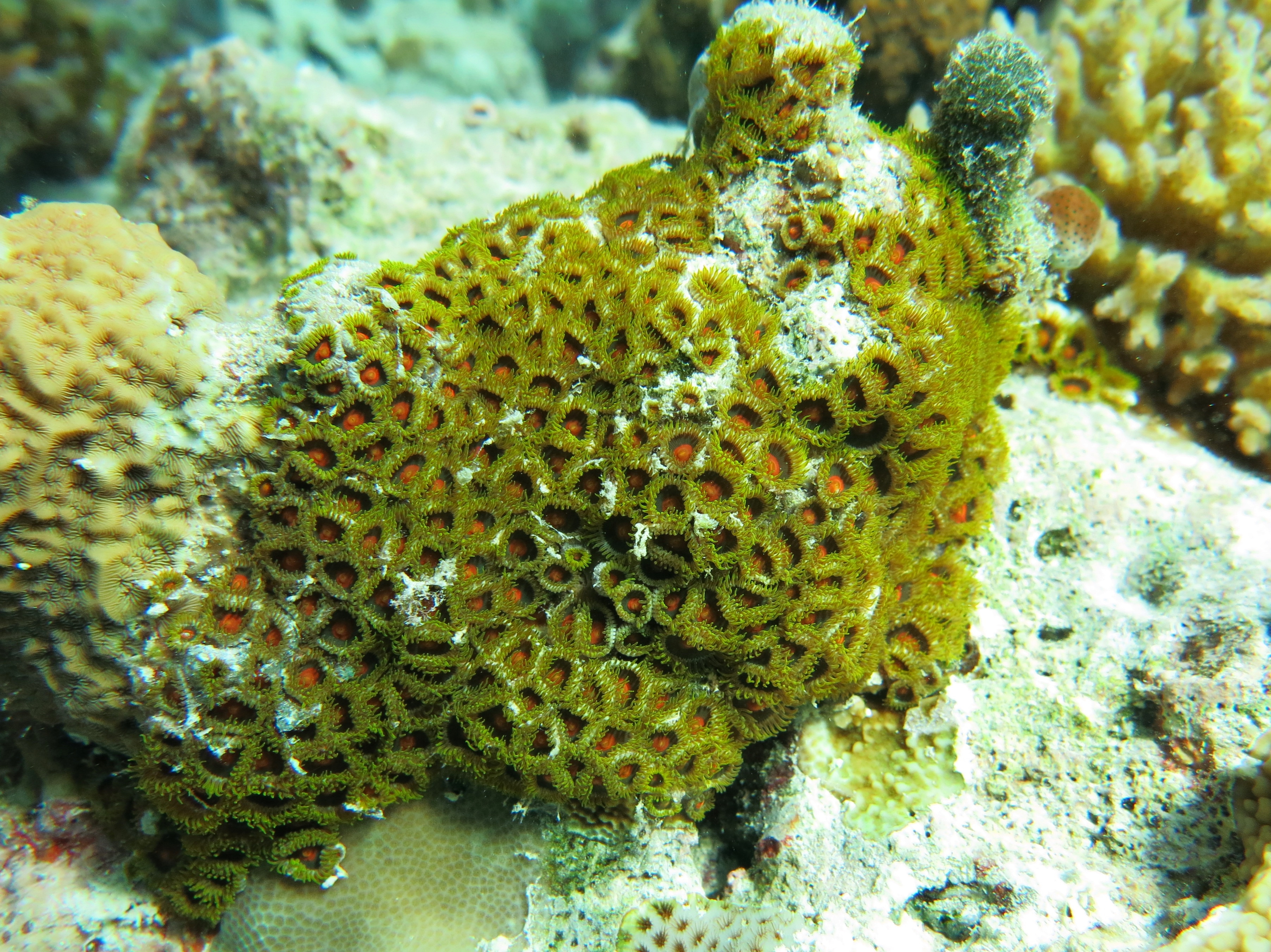
An orange-to-red body with a dark purple/blue central 'eye' and a green-to-yellow skirt, the contrasting dark pupil giving it the eagle-eye look. A foundational hobby morph.
Tip: Hardy and beginner-friendly; place low-to-mid under moderate light and flow. A fast spreader that can shade neighbors, so consider isolating it on its own rock 'island.'
 representative
Fire & Ice →
Popular zoa with icy blue/teal centers ('ice') ringed by orange-red skirts ('fire'). A staple in beginner zoa gardens.
Tip: Color holds best at moderate PAR (~75–125); too much light pushes it brown, too little fades the fiery skirt.
 representative
Rasta →
A classic morph with a yellow-green skirt, orange-red body ring, and a bright yellow center, evoking the red/gold/green Rastafarian palette. One of the most recognizable named zoas in the hobby.
Tip: Place on low-to-mid rockwork under moderate light (PAR ~100-250) and moderate flow; Rastas can be a slower grower and color up best with stable, moderate light rather than blasting PAR.
 representative
People Eater →
A sought-after Palythoa/zoa with a purple mouth, green ring, and orange skirt; one of the most recognizable named zoas.
Tip: As a Paly, it packs extra-potent palytoxin — wear gloves and eye protection when fragging, and never handle dry.
 representative
Sunny D / Sunny Delight →
Bright solid orange zoa polyps that resemble little suns; fast-growing and inexpensive.
Tip: Give it good light to keep the orange saturated; it polyps up fast, making it ideal for filling a frag rack.
 representative
Gobstopper / Bam Bam Orange →
Premium zoas — Gobstoppers show candy-like multicolor rings; Bam Bam Orange is a pink-mouth, orange-skirt collector morph.
Tip: These high-end morphs hold color best with stable nutrients (not ultra-low); siphon any film/cyano off the polyps so they stay open.
 representative
Magician / Wolverine →
Designer-grade zoas with vivid purple/blue and orange contrast, commanding high per-polyp prices.
Tip: Frag onto its own plug and grow out slowly under moderate blue light; the intense purple fades if the colony is shaded by faster corals.
 representative
Nuclear Green / Radioactive Dragon Eye →
Electric neon-green skirt with an orange/red center; one of the most ubiquitous and bulletproof named zoas.
Tip: Extremely beginner-friendly and fast-spreading — give moderate light and watch it carpet the rock; ideal first zoa.
 representative
Rainbow Incinerator →
A famous Zoanthus morph with a fiery orange-to-red center, a deep purple/violet ring, and a bright green skirt, named for its blazing rainbow color spread.
Tip: Hardy under low-to-moderate light and gentle flow; place low-to-mid and it colors up without high PAR. Always wear gloves and eye protection when handling zoas/palys.
 representative
Sunny D →
A metallic orange face with a yellow-and-gold highlighted skirt and a bright green mouth, named for the orange-drink color. Cheerful, saturated orange tones.
Tip: Moderate light brings out the metallic orange face; place mid-tank with moderate flow. Avoid heavy shading, which dulls the orange.
 representative
WWC Bowsers →
A bold zoa with a spiky orange/yellow skirt and dark contrasting body, named after the Mario villain for its menacing fiery look.
Tip: Moderate light and flow, low-to-mid in the tank; warm-colored zoas hold pigment better without excessive PAR.
Magicians →
A zoa (Zoanthus) with a deep purple-to-maroon outer disc, a contrasting red/orange body, and a shimmering blue-teal metallic center near the mouth.
Tip: Blue-heavy lighting at moderate PAR makes the teal center and purple disc fluoresce; keep low-to-mid with gentle flow. One of the easier zoas to grow.
 representative
Armageddon →
A vivid purple mouth surrounded by a rich pink center, an irregular mottled ring of deep purple, and a matching purple skirt. A dramatic red zoa that glows under actinic light.
Tip: A fast, easy grower; place mid rockwork under moderate light and flow. Stable lighting helps hold the purple and pink contrast.
 representative
Blue Hornet →
A blue-faced morph with a green ring and a dark-blue-and-neon-green layered skirt, part of the popular 'Hornet' naming family. Cool blue-dominant coloration.
Tip: Blue tones pop under moderate PAR with blue spectrum; place mid rockwork with moderate flow.
 representative
Gorilla Nipple →
A paly with a green skirt, orange/red ring and prominent pink raised mouth, named for its distinctive protruding center.
Tip: Moderate light and flow; the contrasting mouth shows best low-to-mid in the display. Wear gloves with palys.
 representative
Daisy Cutter →
A zoa with a bright green skirt, vibrant orange-red center and a neon green or yellow mouth, also known as the JF (Jason Fox) Star Gazer.
Tip: Moderate light (PAR ~80-200) with actinic blue enhances color; give room to spread as it grows quickly. Wear gloves and eye protection.
 representative
Tubbs Blue →
A classic blue morph (often associated with Zoanthus danae) with an intense blue-to-blue-violet oral disc encircled by dark reddish-brown tentacles. Prized as one of the more genuinely blue zoas, with color that pops under actinic light.
Tip: Blue coloration holds best under moderate PAR with good blue/actinic spectrum; place mid rockwork with moderate flow. Can be a touchy grower, so keep parameters stable rather than chasing high light.
 representative
King Midas →
A bright yellow/gold center with a blue-to-purple outer ring and a bright yellow-gold skirt, the golden look earning the King Midas name.
Tip: Moderate light keeps the gold saturated without bleaching; place mid rockwork with moderate flow. A solid grower once settled.
 representative
Whammin Watermelon →
A watermelon-themed morph with a green body and pink/red center tones echoing watermelon flesh and rind. A fun, recognizable candy-store name.
Tip: Place mid rockwork under moderate light and gentle-to-moderate flow; stable conditions keep the green-and-pink contrast strong.
 representative
Grand Master Krakatoa →
A high-grade Krakatoa morph, typically a bright yellow outer rim with a pink/red center, the 'Grand Master' grade denoting the most saturated top-tier coloration of the Krakatoa line.
Tip: Place mid-tank under moderate, stable light and low-to-moderate flow; commonly sold as single-polyp or small WYSIWYG frags, so be patient as it establishes.
representativePink Zipper →
A bright pink and dark purple face peppered with glowing pink sparkles, with a teal-blue bar on the skirt giving a 'zippered' look. Sparkly and pink-dominant.
Tip: Moderate light brings out the pink sparkle; place mid rockwork with moderate flow. Avoid overly intense light that washes out the pink.
representativeBamBam →
Most often seen as 'Orange BamBam,' with intense orange fluorescence, thick centers and a ring of deep blue around the center edge. A classic, widely traded named zoa.
Tip: Hardy and adaptable; place low-to-mid under moderate light (PAR ~100-250) and moderate flow. A rapid grower and good beginner named morph.
representativePink Diamonds →
An extraordinarily bright pink face, often with two dimple spots, and a fluorescent yellow skirt over a larger polyp. One of the most intensely pink zoas in the hobby.
Tip: Moderate, stable light keeps the pink face glowing without bleaching; place mid rockwork with moderate flow. A premium, limited-availability morph.
representativeGoblins on Fire →
A bright green center ringed in blue/purple leading out to a fiery red-orange skirt, with the 'on fire' look coming from the flaming outer ring. A high-end collector zoa.
Tip: Place mid rockwork under moderate, stable light (~125-200 PAR) and gentle-to-moderate flow; noted as a medium-slow grower, so be patient as it establishes.
representativeSpeckled Krak →
A Krakatoa-derived morph in warm orange and yellow-green tones with a sparkly speckled face on a larger, hardier polyp than the original Krakatoa.
Tip: Place mid-tank under moderate, stable light and gentle-to-moderate flow; like other Krakatoa-line zoas it rewards patience as it establishes.
representativeNuclear Green →
A Palythoa with an intensely bright, glowing green face. A classic, very fast-spreading 'green paly' staple in the hobby.
Tip: Extremely hardy; place anywhere from sand bed to mid rock under moderate light. It spreads aggressively, so keep it away from slower neighbors.
representativeArmor of God →
Bold, high-impact polyps with strong contrasting color (often bright pink-to-red faces with dark variegation), frequently abbreviated 'AOG' in the trade. A standout, high-visual-punch zoa.
Tip: Place mid rockwork under moderate light (PAR ~100-250) and moderate flow; often sold per-polyp, so expect to grow out small starts patiently.
representativePandora →
A yellowish-gold base with light pink/golden speckling and deep purple-to-magenta skirts giving a starburst appearance, on a larger 'paly'-type polyp. A hardy, fast-growing favorite.
Tip: Very beginner-friendly and fast; place low-to-mid under moderate light and flow. Grows quickly enough to carpet a plug.
representativeRainbow Hornet →
Named for an alternating red-and-orange skirt with a blue face and a bright yellow ring around the mouth. A multicolor member of the Hornet family.
Tip: Place mid rockwork under moderate light to hold the multicolor skirt; moderate flow and stable parameters keep the rainbow tones vivid.
representativeFire and Ice →
A sky-blue mouth rimmed by a dark blue/purple body leading out to a bright orange-to-red skirt, contrasting 'fire' (orange) and 'ice' (blue). A hobby staple.
Tip: Hardy and adaptable; place low-to-mid under moderate light and flow. A reliable spreader and great beginner named zoa.
representativeBlow Pop →
A candy-named morph with a steely/baby-blue face and a contrasting orange mouth and skirt. Often used as a broad name for a colorful sweet-toned zoa.
Tip: Place mid rockwork under moderate light (PAR ~100-250) and moderate flow; an easy, forgiving zoa for new reefers.
Eye of Ra →
An Egyptian-themed morph with a striking contrasting central 'eye,' the dark pupil-like center surrounded by brighter body and skirt tones.
Tip: Place mid rockwork under moderate light to emphasize the central eye contrast; moderate flow and stable parameters.
representativeRastas →
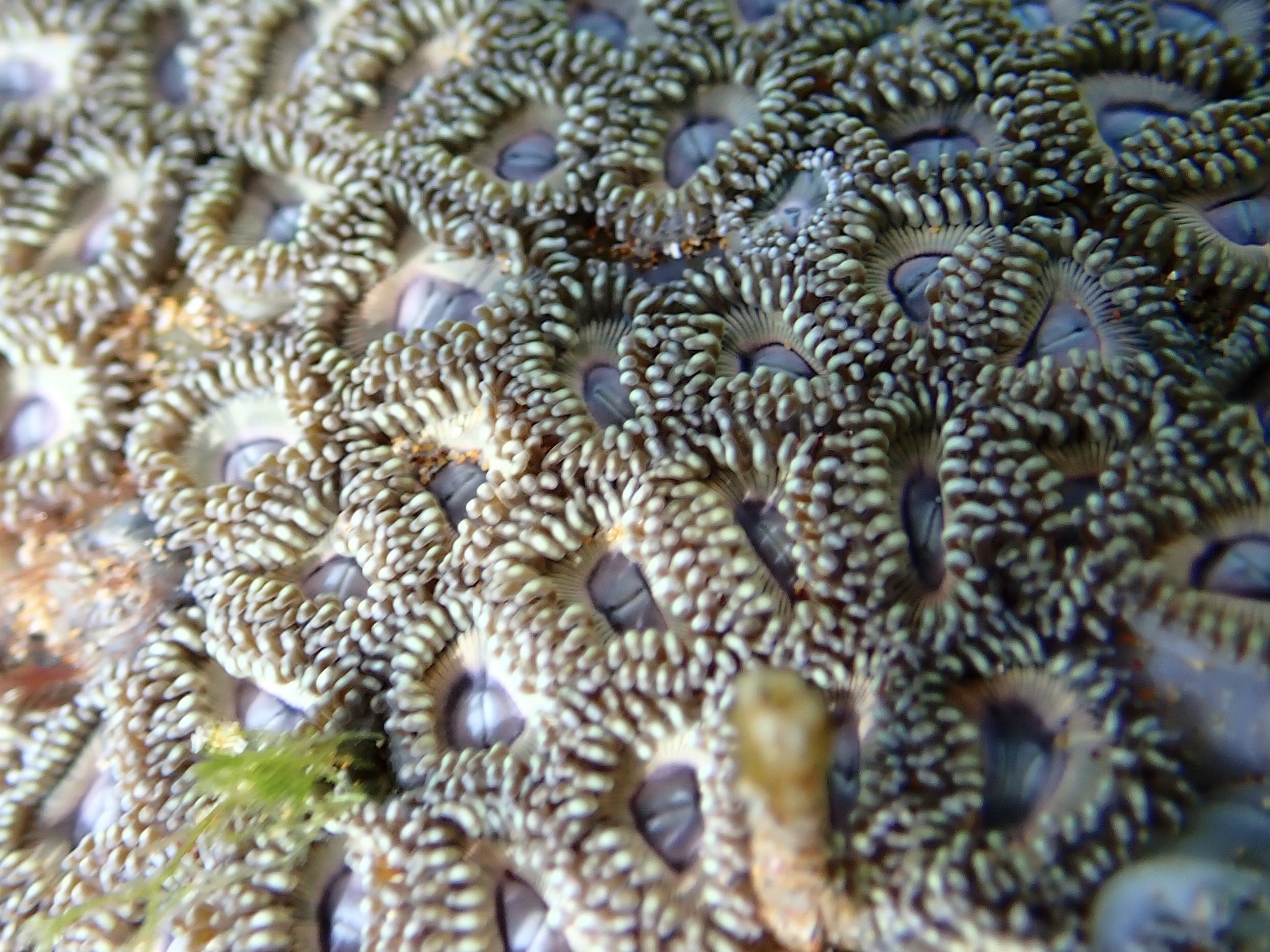
Iconic line-collected morph with green-and-orange centers ringed by red — a trade-named designer zoa.
 representative
Everlasting Gobstopper →
A candy-inspired morph with concentric color rings reminiscent of the Willy Wonka gobstopper, layering multiple bands of color in one polyp.
Tip: Place mid-tank under moderate light (PAR ~100-250) to keep the ringed color bands distinct; moderate flow and stable parameters help it color up.
representativeDaisy Duke's Paly →
A named Palythoa with bold contrasting coloration, sold as a signature designer paly. Larger polyps typical of Palythoa rather than smaller Zoanthus.
Tip: As a paly it tolerates higher light and flow than many small zoas; Jason Fox lists it as high-light/high-flow on mid rockwork. Palys can be aggressive spreaders, so place it away from prized neighbors.
representativeWWC Bob Marley →
A purple skirt and center with a bright green ring and a signature orange ring around the dark center over a neon green body. A vivid, highly sought-after designer zoa.
Tip: Place mid rockwork under moderate, stable light to keep the neon green and orange ring bright; moderate-to-strong flow. Small-to-medium polyps that color up best under steady conditions.
representativeJF Bloodshot →
A bright green polyp with a deep maroon/blood-red center, the red 'bloodshot' eye contrasting against green. A signature Jason Fox zoa.
Tip: Place mid rockwork under moderate, stable light (PAR ~100-250) and gentle-to-moderate flow; a moderately fast grower once established.