Montipora coral
Montipora sp. · also called Monti, Montipora cap, Plating montipora, Encrusting montipora, Velvet coral

Montipora is the beginner-friendly gateway into SPS keeping — a fast-growing acroporid small-polyp stony coral in encrusting, plating ('cap') and branching forms, with a smooth or velvety surface of tiny polyps. It is far more forgiving than Acropora while still rewarding good light and stable chemistry, making it a great intermediate SPS.
🩺 Need expert help with your montipora coral?
Connect with a specialist near you or ask a licensed vet — never substitute online guidance for hands-on care in an emergency.
Quick facts
| Size | Encrusting, plating ('cap') or branching colony with very small polyps; frags ~2-5 cm, plating caps can reach 20-40+ cm across. |
| Lifespan | 5–100 years |
| Social needs | solo |
| Native region | Indo-Pacific |
| Origin | Old World |
| Climate | 🌴 Tropical |
| Water type | 🌊 Marine |
| Family | Acroporidae |
| Genus | Montipora |
Part of the SPS Corals
Small-polyp stony corals — fast-growing branching corals demanding strong light & flow.
Habitat & space requirements
From the minimum an animal needs to be kept humanely, up to the ideal setup. Bigger is almost always better — minimums are floors, not targets.
Life & growth stages
How this animal changes through its life — each stage often has its own care, diet and space needs.
Color & pattern variants
Natural variants occur in the wild; selectively bred (man-made) variants were developed in captivity.
 representative
Montipora capricornis (plating cap) →
Classic whorled plating 'cap' form; common in green, red/orange and purple-rim natural colours.
 representative
Montipora digitata (branching) →
Finger-branching form in green or orange; extremely hardy and fast-growing, often a starter SPS.
 representative
Forest Fire Digitata →
A branching Montipora digitata with a green-to-teal skeleton/base and intense red-to-orange polyps, looking like burning embers in a forest. Shows deeper red under lower light.
Tip: Fast-growing and capable of overtaking neighbors; give it room, moderate-to-high flow and moderate-to-high light (PAR roughly 200-400). It is one of the most beginner-friendly SPS and frags readily.
 representative
Rainbow Montipora →
An encrusting/plating monti with a purple-to-blue base and randomly distributed multi-color polyps in red, yellow, orange and green, giving a 'rainbow' speckled look.
Tip: Place in medium-to-high light and good flow; the multi-color polyps show best under strong PAR with stable alkalinity. It encrusts readily and is one of the easier SPS to keep.
 representative
Pumping / Sunburst Setosa →
Encrusting *M. setosa* with raised, polyp-covered ridges; the 'sunset/sunburst' setosa has an orange base with green or yellow polyps.
Tip: Setosa encrusts aggressively over rock and glass — leave a clear buffer zone around it and keep flow moderate so its fuzzy polyps stay extended.
 representative
Idaho Grape Montipora →
A plating Montipora (often labeled M. capricornis or M. undata) in a uniform deep purple/grape color, frequently with blue polyps and a contrasting growth edge, that whorls and encrusts as it grows.
Tip: Growth form depends heavily on flow; give it open flat rock with moderate flow and moderate-to-strong light so it plates into a smooth purple whorl. It is resilient and tolerant of varied conditions.
 representative
Jedi Mind Trick Montipora →
A high-end multicolor plating Monti with a dark body speckled in red, green, and orange polyp clusters — a named designer collector piece.
Tip: Buy an established frag, not a wild colony; named rainbow Montis only show full color once settled and need months of stable conditions to express the speckling.
 representative
Designer monti morphs (e.g. Sunset, Rainbow, Forest Fire) →
Aquacultured, line-grown colour selections with trade names (e.g. 'Sunset Montipora', 'Rainbow Montipora', 'Forest Fire Digitata') chosen for multicolour polyps and rims.
 representative
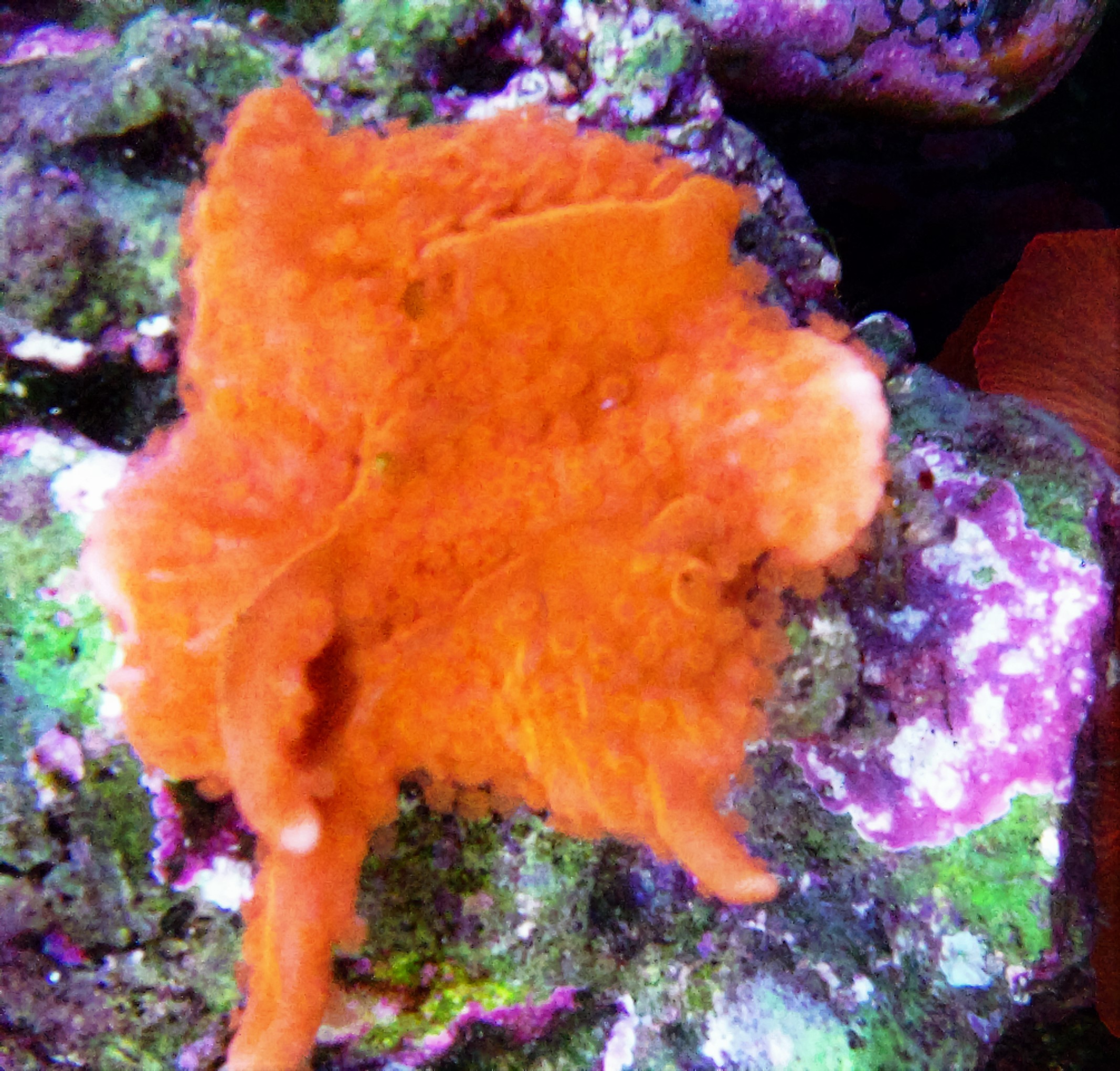
Sunset Montipora →
A plating/encrusting Montipora with an orange-to-red body and contrasting green polyps, giving a glowing 'sunset' gradient across the colony. One of the most recognizable color-morph Montis in the hobby.
Tip: Place mid-to-upper rockwork under moderate-to-high PAR (150-250) with moderate flow; it colors up best with enough light to drive the orange while keeping the green polyps visible.
 representative
Superman Montipora →
A blue-bodied encrusting monti with vivid red polyps, mimicking the Superman color scheme of red-on-blue. It can shift toward a redder body under warmer/seasonal conditions.
Tip: Holds the blue body under moderate-to-high light and benefits from moderate-to-high flow to keep sediment off; it can retain color even under less light than many SPS.
 representative
Sunkist Bonsai Montipora →
A branching/encrusting Montipora prized for a saturated orange ('Sunkist') coloration with fine polyp detail. The pure, even orange body is the selling point.
Tip: Strong, stable light brings out the orange; place upper-rock under high PAR with moderate flow and keep nutrients low-to-moderate so the orange doesn't dull.
 representative
German Blue Polyp Digitata →
A branching Montipora digitata famous for short, vivid blue polyps set against golden-to-white growth tips. The intense blue polyp color is uncommon in the genus and highly sought.
Tip: Blue polyp pigments hold best under cooler, higher-Kelvin light at moderate-high PAR (roughly 300-450); place on upper rock with moderate-to-strong flow and keep alkalinity very stable.
 representative
Pokerstar Montipora →
An encrusting/plating monti with a blue-to-purple base and contrasting bright green polyps in a speckled, polka-dot pattern.
Tip: Medium-to-high light and moderate flow on rock; lower-light spots favor the base color while stronger light brings out polyp pop. Hardy and forgiving.
 representative
WWC Sunset Montipora →
A plating/encrusting cap with warm orange-to-red tissue and contrasting polyps, giving a glowing 'sunset' two-tone look.
Tip: Give it medium-to-strong light and moderate-to-high flow on a rock ledge; the orange tissue colors up best under brighter light. Like most Montipora it is a hardy, forgiving SPS that spreads steadily over the rockwork.
 representative
WWC Mystic Sunset Montipora →
An encrusting Sunset-type monti with a bright orange base and contrasting purple polyps (often described as a Superman Monti with reversed coloration), giving a moodier take on the classic Sunset.
Tip: Medium light (roughly 150-250 PAR) and moderate-to-high flow on a flat rock surface; it spreads gradually over the rockwork and is forgiving for a beginner SPS.
 representative
Reverse Superman Montipora →
The inverse of the standard Superman: a red-bodied monti with bright blue-to-purple polyps instead of red polyps on a blue body. A fast-growing encrusting/plating piece.
Tip: Moderate-to-high light and flow; the red body and blue polyp contrast are light-driven, so keep PAR up and nutrients moderate.
representativeORA German Blue Polyp Digitata →
A round-tipped, multi-branching Montipora digitata in sky-to-deep blue with short bright blue polyps and golden-yellow to white growth tips.
Tip: Wants intense light to hold the blue polyp color; can be placed at any tank height with moderate-to-strong flow. Fast-growing and very hardy.
representativeJF Fruity Pebbles Montipora →
A multicolor monti splashed with pink, blue, green and orange like the cereal it is named after; loses the rainbow look and turns green/orange if given too little light.
Tip: High flow and high light hold the multi-color pattern; place where it gets steady movement and stable parameters. It encrusts and is reasonably hardy but needs strong light to keep its colors.
representativeJF Aquaman Montipora →
A faster-growing encrusting monti with a glowing green-to-aqua base and vivid orange-to-red polyps covering the colony, named in the Jason Fox superhero theme alongside Superman.
Tip: High light and high flow bring out the base color; give it an upper-to-mid rock placement with strong, varied flow. It encrusts down onto the frag/rock as it spreads.
representativeJF Beach Bum Montipora →
A vibrant designer monti pairing neon green polyps with a glowing golden-orange base; especially striking under actinic lighting.
Tip: Around 225 PAR (mid-to-lower placement) with medium alternating flow is the recommended sweet spot for best growth and color. Benefits from occasional target feeding with fine SPS foods.
representativeJF Fire Starter Montipora (Hirsuta) →
A fuzzy-textured Montipora hirsuta with fiery red/orange polyps over a contrasting base, named for its 'fire starter' glow. (A setosa-form Fire Starter is also sold under the JF name.)
Tip: Moderate-to-high flow and moderate-to-bright light (PAR roughly 300-450) with a 14-20K spectrum; the hairy hirsuta texture and red polyps hold best in stable, clean water. It is a fast-growing, fairly easy SPS.
representativeTyree Orange Setosa Montipora →
A Montipora setosa with intense salmon-to-orange tissue and a unique fusing/branching growth form; the orange can shift pinkish under very intense light.
Tip: Aim for roughly 200-300 PAR (it tends to go pink above 300) with moderate-to-high flow and bottom-to-middle placement. Setosa is slower-growing than typical monti, so give it stable parameters and patience.
representativeORAnge Setosa Montipora →
A Montipora setosa famous for intense orange coloration that can appear pink under very high-intensity light, with an unusual undulating, fusing-and-branching growth form and few polyps.
Tip: Give it stable parameters, ideally 200-300 PAR (more can push it pink) and moderate-to-high flow. It is hardy and tolerant of a range of conditions but a relatively slow grower, so don't rush it.
representativeWWC Sunfire Grafted Cap Montipora →
A grafted Montipora cap where polyps on red tissue glow orange and polyps on green tissue glow green, producing a swirling orange/red-on-green plate as two color strains fuse on one cap.
Tip: Lay it flat on open rock with medium light and moderate flow so the two grafted strains plate out and develop the color border. Fast-growing and resilient.
representativeWWC Jedi Mind Trick Montipora →
A Montipora (commonly M. undata) with a sea-green body, an intense violet growth edge and hot red polyps; a high-contrast plating/encrusting piece.
Tip: Medium light (roughly 150-250 PAR) and high flow on rock; strong flow helps it build thick plates rather than thin brittle ones. Fast-growing and beginner-friendly for an SPS.
representativeTSA Tequila Sunrise Grafted Setosa Montipora →
A grafted Montipora setosa where red setosa tissue carries mutated greenish/gold specks, blending orange, gold and red 'sunrise' tones across a single colony. A premium house-grafted showpiece.
Tip: Combine setosa's slower, demanding care (very stable parameters, controlled light) with patience; give it open rock and moderate-to-high flow and expect slow growth. Grafted pieces are best for experienced keepers.