Favites (Pineapple Brain)
Favites abdita · also called Pineapple Brain Coral, Pineapple Coral, Closed Brain, Moon Coral, War Coral (trade)

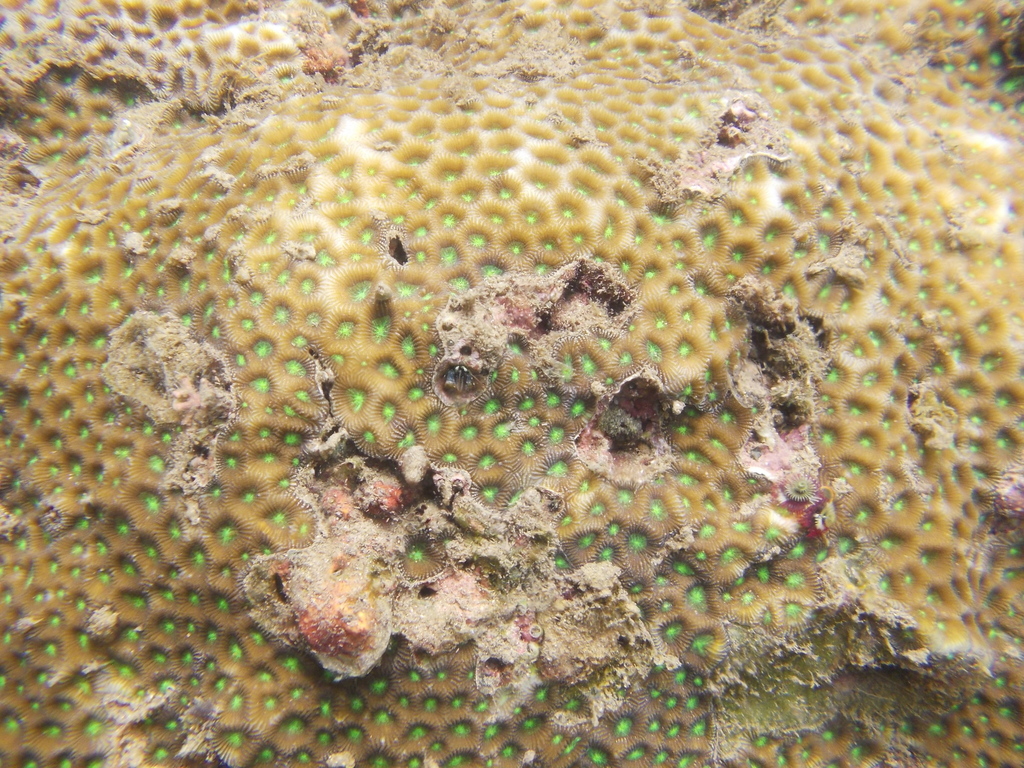
Photo: NPS - Larry Basch · Public domain
Favites abdita is a hardy 'closed brain' LPS forming dome-shaped colonies of cerioid (shared-wall) corallites that give a pineapple-like texture. Colorful and forgiving, it is a great intermediate reef coral but defends itself with potent nighttime sweeper tentacles.
🩺 Need expert help with your favites (pineapple brain)?
Connect with a specialist near you or ask a licensed vet — never substitute online guidance for hands-on care in an emergency.
Quick facts
| Size | Massive/encrusting boulder colonies; corallites ~5-15 mm, aquarium colonies typically 5-25 cm across, can reach much larger in the wild |
| Lifespan | 20–100 years |
| Social needs | solo |
| Native region | Indo-Pacific; Red Sea through East Africa to the Western and Central Pacific |
| Origin | Old World |
| Climate | 🌴 Tropical |
| Water type | 🌊 Marine |
| Family | Merulinidae |
| Genus | Favites |
Part of the LPS Corals
Large-polyp stony corals (brains, Euphyllia, Goniopora, Scolymia, Lobophyllia, Favites, Acan, Dendro, Octospawn) with fleshy polyps over a calcium-carbonate skeleton. Intermediate-care reef corals that appreciate moderate light/flow and direct feeding.
Habitat & space requirements
From the minimum an animal needs to be kept humanely, up to the ideal setup. Bigger is almost always better — minimums are floors, not targets.
Life & growth stages
How this animal changes through its life — each stage often has its own care, diet and space needs.
Color & pattern variants
Natural variants occur in the wild; selectively bred (man-made) variants were developed in captivity.
 representative
Rainbow Favites / War Coral
Multicolor morphs with contrasting wall and valley colors (green, red, purple, gold) marketed under 'War Coral' style names; naturally occurring color forms selected and grown out in the hobby.
 representative
Green/Gold Pineapple
Common color form with green or gold corallite centers and darker walls, giving the classic pineapple-textured closed-brain appearance.
representativeWar Coral →
The classic *Favites pentagona* morph: a green-to-teal body laced with **red 'battle line' splotches** and vivid green polyp mouths, the red-on-green look that gave the coral its name.
Tip: Place low-to-mid in the tank under low-to-moderate light (PAR ~120-200) with gentle, indirect flow; leave 1-2 inches of clearance because favites can put out stinging sweeper tentacles at night. A hardy, forgiving brain that tolerates lower-light corners.
 representative
Reverse War Coral →
An inversion of the classic War Coral pattern: a **green body with red/magenta eyes (mouths)** rather than a red body with green mouths.
Tip: Same as War Coral - lower third of the tank, gentle indirect flow and low-to-moderate light; give it a little space from neighbors. Hardy and brightly colored, an easy brain to keep.
representativeChristmas Favia →
A festive **green-and-red** brain - a green base with red/maroon mouths (and sometimes purple-tinted corallite walls) - that reads like holiday colors. A long-running hobby staple.
Tip: An easy, forgiving brain for lower-light, lower-flow spots in the lower two-thirds of the tank; feed mysis or other meaty foods a couple of times a week to boost color and growth.
representativeDemon Eye Favia →
A menacing brain with **deep red eyes (mouths) set in a dark blue body**, with the whole colony covered in bright speckling.
Tip: Show the red eyes and speckling off under blue light at low-to-moderate intensity with gentle flow in the lower-mid tank; a hardy, easy favia.
representativeGrapetini Favia →
A purple-and-green ('grape') toned brain - a popular, affordable, beginner-friendly named favia.
Tip: Very forgiving in lower-light, lower-flow spots; a great beginner favia for the lower-mid tank.
representativeJF Psycho Rainbow Rim Favia →
A high-end designer brain: **neon green eyes (mouths) surrounded by a robust red/purple rim speckled with neon yellows and greens**, framing the colony when fully extended.
Tip: Give it stable, mature water and low-to-moderate light - it looks best around PAR ~100, where the polyps swell and fluff out. Use gentle, intermittent flow in the mid-lower tank; don't blast it, so the rim colors stay saturated.
representativeJF Day Glo Favia →
An iconic neon brain with **bright green mouths ringed in yellow** fading into warmer outer polyp tissue - extremely fluorescent under blues, with patches of blue pigment that can develop on the ridges.
Tip: Color pops hardest under heavy actinic/blue light; keep it low light and gentle flow and place it below the mid-level of the tank, where this *Favites pentagona* holds its best color. Feed lightly to keep it fluffy.
representativeJF Yellow Submarine Favia →
A bold brain with **intense yellow-to-orange outer polyp tissue and blue inner eyes (mouths)** - an unusual yellow/gold dominant look for a brain coral.
Tip: Easy to care for under minimal light and flow; the yellows hold best with steady blue-rich light that isn't strong enough to bleach. Keep it lower-to-mid tank with gentle flow.
representativeJF Fairy Ring Favia →
Named for the **ring-shaped halo of color encircling each corallite mouth**, giving a repeating 'fairy ring' pattern across the colony.
Tip: Place low-to-mid under moderate blue light and gentle flow so the ringed corallites color up evenly; feed lightly to keep the polyps full.
representativeJF Toro Bravo Favia →
A multicolor designer brain (Spanish for 'brave bull') in **purple, pink and yellow** tones, with contrasting corallite centers and walls.
Tip: Lower-to-mid placement under medium light and medium flow; feed to keep the colors saturated and the polyps plump.
representativeJF Purple People Eater Favia →
A vivid brain with **deep purple centers, lime-green tissue and a sky-blue growth rim** - the blue rim is what really makes this piece stand out.
Tip: Purples and the blue rim can fade under too much light; keep moderate blue-rich light (PAR ~120-180), gentle flow and mid-lower placement, and keep nutrients non-zero (small amounts of nitrate and phosphate) to hold the color.
representativeWWC Fantasmo Favia →
A World Wide Corals house brain with **large, rainbow/multicolor polyps** that glow vividly when fully extended - one of WWC's signature favias.
Tip: Place it low in the tank at low light (WWC recommends PAR around 75 - even less light than most favias) with low to medium-low flow, and let it encrust outward across the rock. Target-feed about once a week when its feeding tentacles are out.
representativeWWC Necromancer Favia →
A dark-walled, eerie brain with glowing green/teal corallite centers contrasting against deep base tissue.
Tip: Show the contrast off under blues with medium light and medium flow in the mid-lower tank; rated an easy-care favia by WWC.
representativeWWC Kraken Favia →
A bold WWC house brain with strong corallite contrast and saturated coloration across the colony.
Tip: Lower-mid placement, medium blue light and medium flow; a hardy, forgiving aquacultured favia.
representativeWWC Hot Wheels Favia →
A WWC house brain with intense, high-contrast multicolor corallites - a standout favia in their lineup.
Tip: Medium-to-low light and medium flow in the lower-mid tank; keep parameters stable and feed sparingly to maintain the bright contrast.
representativeTSA Wolverine Favia →
A high-contrast brain with **clawed, slashing red/orange corallite lines** against a darker body - the look that earned the 'Wolverine' name.
Tip: Lower-mid placement under low-to-moderate light and gentle flow; a forgiving piece that tolerates lower-light corners.
representativeTSA Inferno Favia →
A blazing red/orange brain ('inferno') with hot corallite centers and a fiery overall tone.
Tip: Lower-mid placement, gentle flow and low-to-moderate light; feed meaty foods a couple of times a week to keep the reds rich.
representativeTSA Pandemic Favia →
A heavily multicolored, busy brain with a mottled, spreading pattern of contrasting color across the corallites.
Tip: Low-to-moderate blue light and gentle flow in the lower-mid tank; let the polyps extend fully to show the whole pattern.
representativeTSA Black Mamba Favia →
A dramatic dark-bodied ('black') brain with electric green/neon corallite centers cutting through the deep base tissue.
Tip: Dark tissue can lighten under intense light - keep moderate blues and gentle flow in the lower-mid tank to hold the contrast.
representativeCB Angel Eye Favia →
A bright brain defined by clean, glowing corallite centers ('angel eyes') ringed with contrasting halo color.
Tip: Moderate blue light (PAR ~100-150) and gentle, indirect flow in the lower-mid tank; feed lightly to keep the corallites well-formed and colorful.
Habitat & enclosure
Substrate
Equipment & setup
Diet
Behavior & temperament
Health
Tips, DIY & hacks
Sources
- WoRMS - Favites abdita (Ellis & Solander, 1786) (database)
- Aquarium Corals (Eric Borneman) (reference)
- Reef2Reef - Favites/Closed Brain Care (care guide)
- Wikipedia: Favites (Pineapple Brain) (wiki)